<?xml version="1.0" encoding="utf-8"?><feed xmlns="http://www.w3.org/2005/Atom" ><generator uri="https://jekyllrb.com/" version="3.9.5">Jekyll</generator><link href="https://www.nihongonoashiba.com/feed.xml" rel="self" type="application/atom+xml" /><link href="https://www.nihongonoashiba.com/" rel="alternate" type="text/html" /><updated>2024-04-21T23:45:44+00:00</updated><id>https://www.nihongonoashiba.com/feed.xml</id><title type="html">Ashiba 足場</title><subtitle>A path to Japanese fluency for busy people.</subtitle><author><name>Ryotsu 両津</name></author><entry><title type="html">The Ergonomic Mnemonic</title><link href="https://www.nihongonoashiba.com/blog/ergonomic-mnemonic/" rel="alternate" type="text/html" title="The Ergonomic Mnemonic" /><published>2024-01-11T00:00:00+00:00</published><updated>2024-01-11T00:00:00+00:00</updated><id>https://www.nihongonoashiba.com/blog/ergonomic-mnemonic</id><content type="html" xml:base="https://www.nihongonoashiba.com/blog/ergonomic-mnemonic/"><![CDATA[<p>It’s all too easy to spend unnecessary time and effort when you start studying kanji because there is so much you could be studying and the goal of kanji study is not entirely clear. Should you be writing each kanji by hand with proper stroke order? Do you need to start with the radicals first? And should you learn a mnemonic for each kanji?</p>

<p>There’s a lot of conflicting advice about what is effective or useful, but the answer becomes clear once you understand your goals. If your goal is to <em>read</em> Japanese—which is the goal of most learners—then taking an approach meant to help you <em>write</em> Japanese is not in your best interest.  Reading kanji does not require the same degree of mastery as writing kanji, so intensive study techniques like learning radicals, creating mnemonics, and handwriting kanji are often overkill.</p>

<p>While effective, these efforts help you go beyond <strong>recognition</strong>, which is all you need to read, and instead teach you how to <strong>reproduce</strong> each kanji, which is what you need to write. Because most learners don’t care about handwriting kanji, they inadvertently spend large and unnecessary amounts of their precious time learning to <strong>reproduce</strong> each kanji, which is orders of magnitude more demanding that the effort required to merely <strong>recognize</strong> kanji. In short, they are studying kanji <a href="/blog/how-not-to-study-kanji/">the wrong way</a>, which at best slows down their progress, and at worst, burns out their desire to learn Japanese altogether.</p>

<p>However, there are still times when it will be efficient to adopt some of the more intensive study methods to help remember and distinguish certain kanji. Specifically, it can be more efficient to learn the occasional mnemonic or write out a kanji when the <a href="/blog/how-to-study-kanji/">recognition-based method</a> for learning kanji falls short. So when does this happen?</p>

<p>To understand, first let’s review how the recognition-based method for learning kanji works.</p>

<p>The recognition-based method for studying kanji relies solely on a consistent study of flashcards. Flashcards help you <a href="/blog/flashcards-will-not-make-you-fluent/">practice</a> kanji and build a recognition of them through spaced repetition. And the best kanji flashcards are those that will help you remember kanji the quickest. Such flashcards will teach you a single clear, distinct, and useful meaning to associate with each kanji in combination with example words that use the meaning of the kanji you are trying to learn.</p>

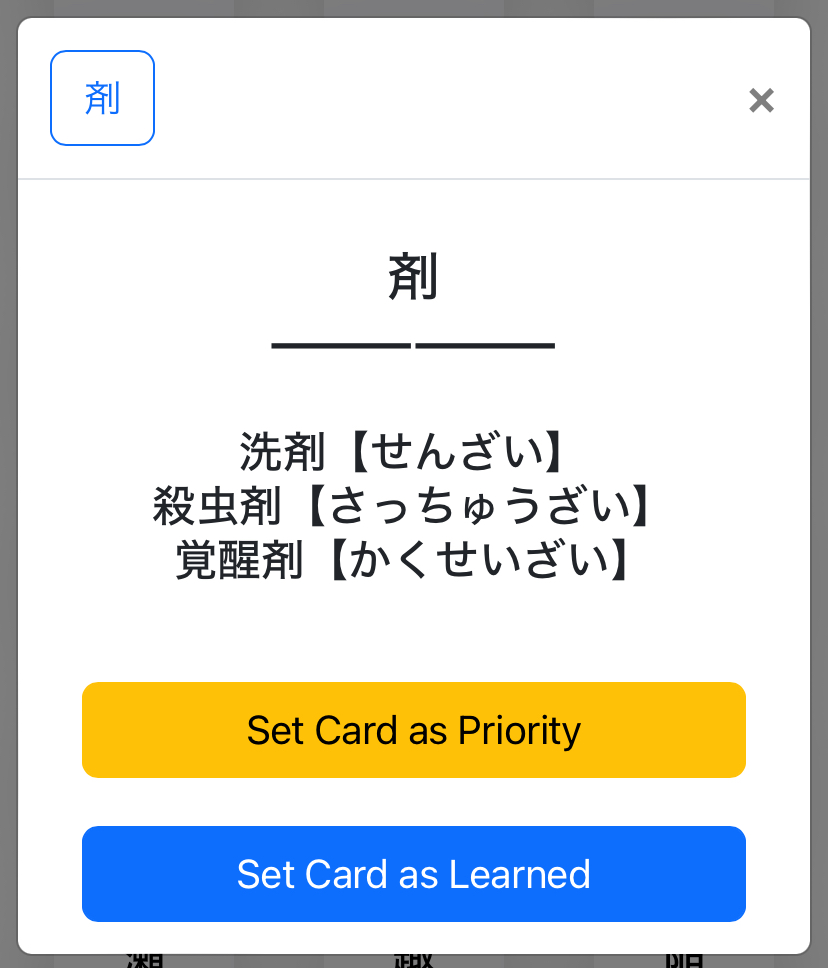
<p>For example, the Ashiba kanji card for 剤 shows a target kanji, and three example words that use the kanji:</p>

<p><img src="/assets/images/blog/ergonomic-mnemonic1.jpg" alt="alt" class="align-center" style="width: 60%;" /></p>

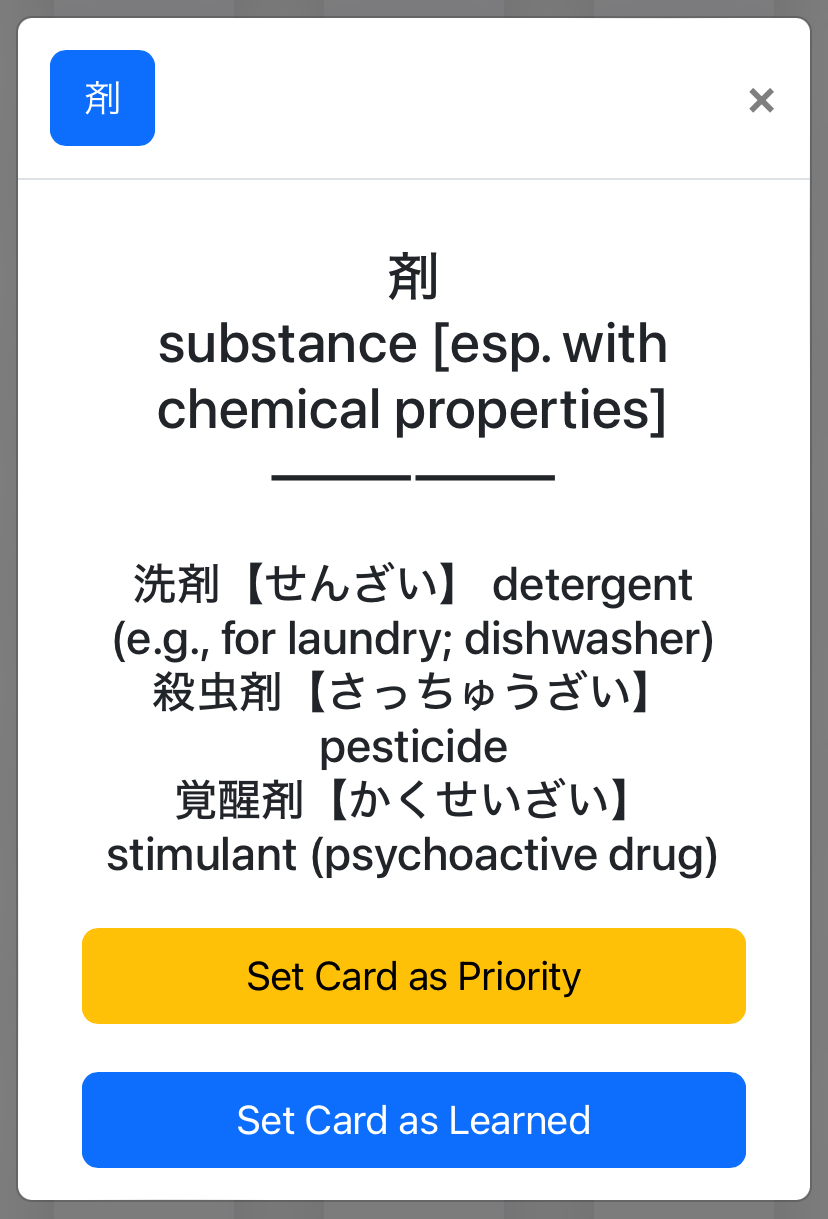
<p>Studying this card involves trying to learn/remember a meaning that is associated with the kanji 剤. Below the line separating the target kanji 剤 are some common words that use 剤 that act as a memory aid by helping make the target meaning concrete and understandable. After reviewing the kanji and the associated words, you will then check the answer to see if you got the correct meaning for 剤:</p>

<p><img src="/assets/images/blog/ergonomic-mnemonic2.jpg" alt="alt" class="align-center" style="width: 60%;" /></p>

<p>In the case of 剤, the keyword is “substance [esp. with chemical properties],” and the examples 洗剤 (detergent), 殺虫剤 (pesticide), and 覚醒剤 (stimulant) help you understand and remember the meaning of 剤 by providing context: a substance used for washing (洗) = detergent, a substance used to kill (殺) bugs (虫) = a pesticide, and a substance used to wake you up (覚醒) = a stimulant.</p>

<p>Studying kanji flashcards designed for the recognition of kanji, such as those provided by the Ashiba app, are the best way to learn kanji. This is because they contain the minimum amount of information required for you to distinguish and remember each kanji while not teaching you too much to slow you down or muddle your memory.</p>

<p>However, there are times when even a consistent study of flashcards will fail to help you remember a kanji-meaning pair. Whether it’s an poorly designed flashcard, confusing similiarity to other kanji, or just your mind’s stubborn refusal to remember, you will invariably find that there are certain cards that you just can’t seem to learn and keep forgetting. When the usual methods fail—and only when the usual methods fail—you should resort to a more intensive study for such kanji.</p>

<p>For instance, it can be hard to remember to 剤 if you have already learned 済. And to make matters worse, you will have to learn 斉 as well! When you find yourself mixing up similar kanji or failing to remember a distinct or complex kanji, taking the time to write it out by hand, studying the radicals that it is made up of, or even learning a mnemonic will be necessary to help you efficiently learn these troublesome kanji.</p>

<p>Putting in some extra effort when you need it will actually save you time in the long run, because it will help your memory hold onto a distinct kanji-meaning association sooner. It’s much better to put in a few extra minutes to write out a kanji or learn a mnemonic than to keep forgetting it week after week.</p>

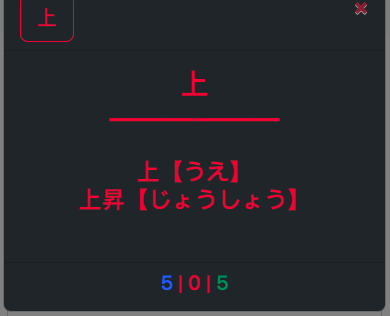
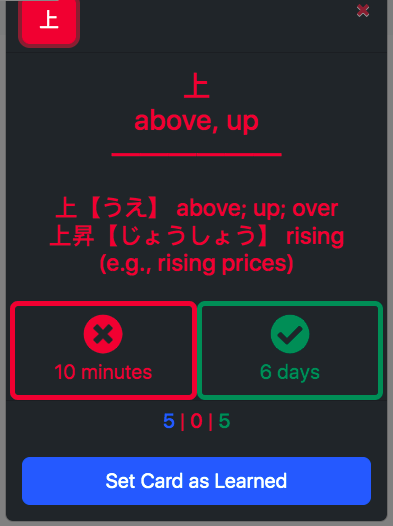
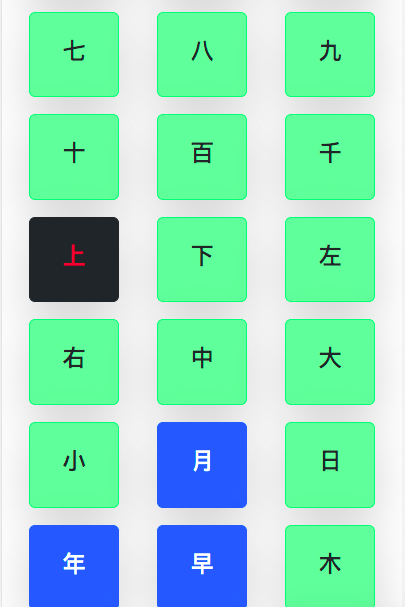
<p>But how do you know when you need to learn a mnemonic or start writing kanji out by hand? The trick is to track your study so you know when you are struggling to learn a particular kanji. Fortunately for you, Ashiba does this automatically. If you are struggling with a card, the Ashiba app will automatically flag it as an Akuma card 😈, and its appearance will forever change to a black background with red text, as shown by the kanji card 上 below:</p>

<p><img src="/assets/images/blog/ergonomic-mnemonic3.png" alt="alt" class="align-center" style="width: 60%;" /></p>

<p><img src="/assets/images/blog/ergonomic-mnemonic4.png" alt="alt" class="align-center" style="width: 60%;" /></p>

<p><img src="/assets/images/blog/ergonomic-mnemonic5.png" alt="alt" class="align-center" style="width: 60%;" /></p>

<p class="notice--warning"><strong>Note:</strong> If you are using Anki as your SRS, Anki flags cards you are struggling to remember as <a href="https://docs.ankiweb.net/leeches.html" target="_blank" rel="noopener noreferrer">“leeches”</a>. Instead of changing the appearance of a card, Anki will suspend a leech so it leaves the study queue. This default behavior always bugged me as well intentioned but misguided, because the solution is not to give up on a card, but to give it more attention. This feature is just one of the many reasons I created Ashiba as a standalone SRS and Anki alternative for learning Japanese.</p>

<p>When you see an Akuma card come up for review, you will be alerted that you are struggling to learn it. So when you see a black and red card show up, you will know that it’s time to put in some extra effort to keep your study as efficient as possible.</p>

<p>Whether you use Ashiba or another SRS, remember to keep your kanji study centered on flashcards instead of unecessary intensive study methods. But when you struggle to remember a card consistently, don’t hesitate to write it out, learn the radicals, or create a mnemonic. Doing so will help you avoid frustruation and continue your efficient learning of Japanese.</p>]]></content><author><name>Ryotsu 両津</name></author><category term="Blog" /><category term="lanaguage learning" /><category term="standard" /><summary type="html"><![CDATA[It’s all too easy to spend unnecessary time and effort when you start studying kanji because there is so much you could be studying and the goal of kanji study is not entirely clear. Should you be writing each kanji by hand with proper stroke order? Do you need to start with the radicals first? And should you learn a mnemonic for each kanji? There’s a lot of conflicting advice about what is effective or useful, but the answer becomes clear once you understand your goals. If your goal is to read Japanese—which is the goal of most learners—then taking an approach meant to help you write Japanese is not in your best interest. Reading kanji does not require the same degree of mastery as writing kanji, so intensive study techniques like learning radicals, creating mnemonics, and handwriting kanji are often overkill. While effective, these efforts help you go beyond recognition, which is all you need to read, and instead teach you how to reproduce each kanji, which is what you need to write. Because most learners don’t care about handwriting kanji, they inadvertently spend large and unnecessary amounts of their precious time learning to reproduce each kanji, which is orders of magnitude more demanding that the effort required to merely recognize kanji. In short, they are studying kanji the wrong way, which at best slows down their progress, and at worst, burns out their desire to learn Japanese altogether. However, there are still times when it will be efficient to adopt some of the more intensive study methods to help remember and distinguish certain kanji. Specifically, it can be more efficient to learn the occasional mnemonic or write out a kanji when the recognition-based method for learning kanji falls short. So when does this happen? To understand, first let’s review how the recognition-based method for learning kanji works. The recognition-based method for studying kanji relies solely on a consistent study of flashcards. Flashcards help you practice kanji and build a recognition of them through spaced repetition. And the best kanji flashcards are those that will help you remember kanji the quickest. Such flashcards will teach you a single clear, distinct, and useful meaning to associate with each kanji in combination with example words that use the meaning of the kanji you are trying to learn. For example, the Ashiba kanji card for 剤 shows a target kanji, and three example words that use the kanji: Studying this card involves trying to learn/remember a meaning that is associated with the kanji 剤. Below the line separating the target kanji 剤 are some common words that use 剤 that act as a memory aid by helping make the target meaning concrete and understandable. After reviewing the kanji and the associated words, you will then check the answer to see if you got the correct meaning for 剤: In the case of 剤, the keyword is “substance [esp. with chemical properties],” and the examples 洗剤 (detergent), 殺虫剤 (pesticide), and 覚醒剤 (stimulant) help you understand and remember the meaning of 剤 by providing context: a substance used for washing (洗) = detergent, a substance used to kill (殺) bugs (虫) = a pesticide, and a substance used to wake you up (覚醒) = a stimulant. Studying kanji flashcards designed for the recognition of kanji, such as those provided by the Ashiba app, are the best way to learn kanji. This is because they contain the minimum amount of information required for you to distinguish and remember each kanji while not teaching you too much to slow you down or muddle your memory. However, there are times when even a consistent study of flashcards will fail to help you remember a kanji-meaning pair. Whether it’s an poorly designed flashcard, confusing similiarity to other kanji, or just your mind’s stubborn refusal to remember, you will invariably find that there are certain cards that you just can’t seem to learn and keep forgetting. When the usual methods fail—and only when the usual methods fail—you should resort to a more intensive study for such kanji. For instance, it can be hard to remember to 剤 if you have already learned 済. And to make matters worse, you will have to learn 斉 as well! When you find yourself mixing up similar kanji or failing to remember a distinct or complex kanji, taking the time to write it out by hand, studying the radicals that it is made up of, or even learning a mnemonic will be necessary to help you efficiently learn these troublesome kanji. Putting in some extra effort when you need it will actually save you time in the long run, because it will help your memory hold onto a distinct kanji-meaning association sooner. It’s much better to put in a few extra minutes to write out a kanji or learn a mnemonic than to keep forgetting it week after week. But how do you know when you need to learn a mnemonic or start writing kanji out by hand? The trick is to track your study so you know when you are struggling to learn a particular kanji. Fortunately for you, Ashiba does this automatically. If you are struggling with a card, the Ashiba app will automatically flag it as an Akuma card 😈, and its appearance will forever change to a black background with red text, as shown by the kanji card 上 below: Note: If you are using Anki as your SRS, Anki flags cards you are struggling to remember as “leeches”. Instead of changing the appearance of a card, Anki will suspend a leech so it leaves the study queue. This default behavior always bugged me as well intentioned but misguided, because the solution is not to give up on a card, but to give it more attention. This feature is just one of the many reasons I created Ashiba as a standalone SRS and Anki alternative for learning Japanese. When you see an Akuma card come up for review, you will be alerted that you are struggling to learn it. So when you see a black and red card show up, you will know that it’s time to put in some extra effort to keep your study as efficient as possible. Whether you use Ashiba or another SRS, remember to keep your kanji study centered on flashcards instead of unecessary intensive study methods. But when you struggle to remember a card consistently, don’t hesitate to write it out, learn the radicals, or create a mnemonic. Doing so will help you avoid frustruation and continue your efficient learning of Japanese.]]></summary></entry><entry><title type="html">Flashcards Will Not Make You Fluent (But They Help)</title><link href="https://www.nihongonoashiba.com/blog/flashcards-will-not-make-you-fluent/" rel="alternate" type="text/html" title="Flashcards Will Not Make You Fluent (But They Help)" /><published>2023-11-15T00:00:00+00:00</published><updated>2023-11-15T00:00:00+00:00</updated><id>https://www.nihongonoashiba.com/blog/flashcards-will-not-make-you-fluent</id><content type="html" xml:base="https://www.nihongonoashiba.com/blog/flashcards-will-not-make-you-fluent/"><![CDATA[<p>Perhaps no study tool receives as much conflicting, competing, and heated advice as that surrounding the use of flashcards and <a href="https://en.wikipedia.org/wiki/Spaced_repetition" target="_blank" rel="noopener noreferrer">spaced repetition</a> systems (SRSs). However, using (and understanding how to use) flashcards and an SRS is essential to <a href="/blog/what-is-high-torque-japanese/">learning Japanese efficiently</a>. So allow me to enter the fray.</p>
<p>The <a href="/blog/SRSly-what-is-the-deal-with-flashcards/">benefits to using flashcards</a> to learn Japanese are well understood. But that doesn’t mean it’s obvious how to use flashcards in an efficient manner. The key to using flashcards efficiently is understanding what flashcards are doing for you in the first place.</p>

<p>Flashcards help you learn a piece of information so that you do not forget it, ideally in the least amount of time and with the least amount of effort possible. Flashcards are a method of <a href="/blog/studying-is-not-learning/">study</a>, and not to be confused with <a href="/blog/inputting-a-language/">inputting</a>, which is the only path to fluency. This means flashcards alone will never lead you to truly understand a language. But if used properly, flashcards can take you to the edge of understanding in a flash.</p>

<p>And that’s because flashcards are the fastest way to practice a language.</p>

<h1 id="why-do-we-practice">Why Do We Practice?</h1>

<p>If you are learning how to do something entirely new, practicing is a key first step. Whether it is learning how to swing a tennis racket or learn a new word, practice is what helps you build the foundation that allows you to ultimately play a tennis match or understand a conversation. Practice <strong>primes</strong> your mind and body so that you can engage with an unfamiliar activity effectively.</p>

<p>The key feature of practice is that it is not the real thing–it is an isolated, simplified study.</p>

<p>Practicing removes variables that would otherwise limit your ability to repeat an action over and over again. In a practice setting, it’s easy to hit 10 forehands in a minute. Compare that to a tennis match where you will alternate between hitting forehands, backhands, serving, and volleying. And that’s assuming you can get the ball over the net in the first place. By practicing your forehand—an isolated study—you can get more reps in over a shorter period of time than you would otherwise by going live.</p>

<p>And getting reps in is key, because repetition is the key to learning something new.</p>

<p>Repetition helps us learn because it builds the neural infrastructure required to perform a new skill. Repetition forces your synapses to fire in a specific way, which will initially forge new neural pathways in your brain. With continued repetitions, you will myelinate the neurons along those new pathways to make synaptic transmission efficient. In this way repetition wires your brain so you can do something new, and then do it well.</p>

<p>Repetition also has the benefit of helping you avoid the frustration of “forgetting” what you are trying to learn. Forging neural pathways is hard work because by definition, you don’t know how to do what you are trying to learn. This means you will have to repeat your attempts multiple times to lay the necessary neural infrastructure to perform a new skill. But to make matters worse, neural pathways erode if they are not reinforced, and newly formed pathways can fall apart quickly. This means that even if you have something down on day 1, you may have forgotten how to do it by day 4.</p>

<p>Practice is a low effort and quick way to get repetitions in so you forge and reinforce neural pathways so you don’t lose the benefits of the effort you have already put in. This is the key insight behind a SRS, which is an app that uses algorithms to determine when you need to practice a flashcard to avoid forgetting. By determining when you are about to forget, the SRS will have you practice the relevant flashcard at the right time. In this way, the SRS is able to minimize the amount of time you spend practicing.</p>

<p>This is great, because it means you can rely on a SRS to keep your brain primed for when you encounter the information you practiced in the wild (i.e., by inputting).</p>

<h1 id="practicing-alone-will-not-create-true-understanding">Practicing Alone Will Not Create True Understanding</h1>

<p>Practicing is effective because it allows you to efficiently get the repetitions you need so you can build the necessary neural infrastructure required to perform a new skill as quickly as possible. But gaining quick reps in an isolated, static environment does not create the finesse that is required to execute this same skill when you are in the full, dynamic environment. This means that to truly learn a new skill, you must move beyond practice to execution in the real world.</p>

<p>Just as martial artists have not learned a new technique until they have executed it while sparring, you will not learn a word in Japanese until you recognize and understand it while inputting. Martial artists will spend countless hours practicing a single technique with a motionless opponent before trying to execute it in a live spar. Practicing a technique prepares them to learn it by forging the foundational neural pathways and making their movements efficient. But their understanding will remain incomplete until the technique is successfully executed in a live spar and the correct neural pathway is established.</p>

<p>Similarly, the SRS will help direct your practice of new information in Japanese so you efficiently forge and maintain neural pathways for new words, phrases and kanji that you want to learn. But the SRS will only prime your mind to learn the information you have practiced. You will need to successfully execute what you have practiced in the real world to learn and complete the construction of your primed neural pathways.</p>

<p>This means you should practice flashcards no more than is necessary to prime your brain for understanding, and then input until you acquire understanding. Doing otherwise will waste your time and delay your learning.</p>

<p>Keep in mind that just as it takes time and effort to build your rough neural infrastructure through practice, it takes time and effort to go from <strong>primed to learn</strong> to <strong>learned</strong>. Successfully making this leap may not happen on your first, second, third, or even your hundredth attempt in the real world. Practicing does not guarantee a smooth and easy transition to understanding—it merely puts you in a position to have a shot at understanding.</p>

<p>It’s obvious that executing a martial arts technique you practiced against a motionless opponent is far more difficult to execute when your opponent is simultaneously trying to take you down. Similarly, understanding a word in spoken conversation that you have practiced may not happen even if you know it is coming and recognize when it is said! When that happens, don’t beat yourself up—recognize that this is just how learning works.</p>

<h1 id="flashcards-will-not-make-you-fluent-but-they-help">Flashcards Will Not Make You Fluent (But They Help)</h1>

<p>You should see now that flashcards—and the SRS systems that direct your study—are a tool for practicing. Flashcards can help you pick up rarely used words if you are fluent, or help lay the foundation of essential vocabulary if you are a beginner. Flashcards are a quick way to get the reps you need so your mind is primed and ready to try and understand what you have practiced in the real world.</p>

<p>Used properly, flashcards can help you learn Japanese at a ridiculous velocity. The key is to use flashcards just enough so you are primed to learn and no more. This way you can spend your time dialing in your understanding by inputting Japanese in the wild instead of wasting your time with unnecessary repetitions.</p>]]></content><author><name>Ryotsu 両津</name></author><category term="Blog" /><category term="lanaguage learning" /><category term="standard" /><summary type="html"><![CDATA[Perhaps no study tool receives as much conflicting, competing, and heated advice as that surrounding the use of flashcards and spaced repetition systems (SRSs). However, using (and understanding how to use) flashcards and an SRS is essential to learning Japanese efficiently. So allow me to enter the fray. The benefits to using flashcards to learn Japanese are well understood. But that doesn’t mean it’s obvious how to use flashcards in an efficient manner. The key to using flashcards efficiently is understanding what flashcards are doing for you in the first place. Flashcards help you learn a piece of information so that you do not forget it, ideally in the least amount of time and with the least amount of effort possible. Flashcards are a method of study, and not to be confused with inputting, which is the only path to fluency. This means flashcards alone will never lead you to truly understand a language. But if used properly, flashcards can take you to the edge of understanding in a flash. And that’s because flashcards are the fastest way to practice a language. Why Do We Practice? If you are learning how to do something entirely new, practicing is a key first step. Whether it is learning how to swing a tennis racket or learn a new word, practice is what helps you build the foundation that allows you to ultimately play a tennis match or understand a conversation. Practice primes your mind and body so that you can engage with an unfamiliar activity effectively. The key feature of practice is that it is not the real thing–it is an isolated, simplified study. Practicing removes variables that would otherwise limit your ability to repeat an action over and over again. In a practice setting, it’s easy to hit 10 forehands in a minute. Compare that to a tennis match where you will alternate between hitting forehands, backhands, serving, and volleying. And that’s assuming you can get the ball over the net in the first place. By practicing your forehand—an isolated study—you can get more reps in over a shorter period of time than you would otherwise by going live. And getting reps in is key, because repetition is the key to learning something new. Repetition helps us learn because it builds the neural infrastructure required to perform a new skill. Repetition forces your synapses to fire in a specific way, which will initially forge new neural pathways in your brain. With continued repetitions, you will myelinate the neurons along those new pathways to make synaptic transmission efficient. In this way repetition wires your brain so you can do something new, and then do it well. Repetition also has the benefit of helping you avoid the frustration of “forgetting” what you are trying to learn. Forging neural pathways is hard work because by definition, you don’t know how to do what you are trying to learn. This means you will have to repeat your attempts multiple times to lay the necessary neural infrastructure to perform a new skill. But to make matters worse, neural pathways erode if they are not reinforced, and newly formed pathways can fall apart quickly. This means that even if you have something down on day 1, you may have forgotten how to do it by day 4. Practice is a low effort and quick way to get repetitions in so you forge and reinforce neural pathways so you don’t lose the benefits of the effort you have already put in. This is the key insight behind a SRS, which is an app that uses algorithms to determine when you need to practice a flashcard to avoid forgetting. By determining when you are about to forget, the SRS will have you practice the relevant flashcard at the right time. In this way, the SRS is able to minimize the amount of time you spend practicing. This is great, because it means you can rely on a SRS to keep your brain primed for when you encounter the information you practiced in the wild (i.e., by inputting). Practicing Alone Will Not Create True Understanding Practicing is effective because it allows you to efficiently get the repetitions you need so you can build the necessary neural infrastructure required to perform a new skill as quickly as possible. But gaining quick reps in an isolated, static environment does not create the finesse that is required to execute this same skill when you are in the full, dynamic environment. This means that to truly learn a new skill, you must move beyond practice to execution in the real world. Just as martial artists have not learned a new technique until they have executed it while sparring, you will not learn a word in Japanese until you recognize and understand it while inputting. Martial artists will spend countless hours practicing a single technique with a motionless opponent before trying to execute it in a live spar. Practicing a technique prepares them to learn it by forging the foundational neural pathways and making their movements efficient. But their understanding will remain incomplete until the technique is successfully executed in a live spar and the correct neural pathway is established. Similarly, the SRS will help direct your practice of new information in Japanese so you efficiently forge and maintain neural pathways for new words, phrases and kanji that you want to learn. But the SRS will only prime your mind to learn the information you have practiced. You will need to successfully execute what you have practiced in the real world to learn and complete the construction of your primed neural pathways. This means you should practice flashcards no more than is necessary to prime your brain for understanding, and then input until you acquire understanding. Doing otherwise will waste your time and delay your learning. Keep in mind that just as it takes time and effort to build your rough neural infrastructure through practice, it takes time and effort to go from primed to learn to learned. Successfully making this leap may not happen on your first, second, third, or even your hundredth attempt in the real world. Practicing does not guarantee a smooth and easy transition to understanding—it merely puts you in a position to have a shot at understanding. It’s obvious that executing a martial arts technique you practiced against a motionless opponent is far more difficult to execute when your opponent is simultaneously trying to take you down. Similarly, understanding a word in spoken conversation that you have practiced may not happen even if you know it is coming and recognize when it is said! When that happens, don’t beat yourself up—recognize that this is just how learning works. Flashcards Will Not Make You Fluent (But They Help) You should see now that flashcards—and the SRS systems that direct your study—are a tool for practicing. Flashcards can help you pick up rarely used words if you are fluent, or help lay the foundation of essential vocabulary if you are a beginner. Flashcards are a quick way to get the reps you need so your mind is primed and ready to try and understand what you have practiced in the real world. Used properly, flashcards can help you learn Japanese at a ridiculous velocity. The key is to use flashcards just enough so you are primed to learn and no more. This way you can spend your time dialing in your understanding by inputting Japanese in the wild instead of wasting your time with unnecessary repetitions.]]></summary></entry><entry><title type="html">What Is High-Torque Japanese?</title><link href="https://www.nihongonoashiba.com/blog/what-is-high-torque-japanese/" rel="alternate" type="text/html" title="What Is High-Torque Japanese?" /><published>2023-11-08T00:00:00+00:00</published><updated>2023-11-08T00:00:00+00:00</updated><id>https://www.nihongonoashiba.com/blog/what-is-high-torque-japanese</id><content type="html" xml:base="https://www.nihongonoashiba.com/blog/what-is-high-torque-japanese/"><![CDATA[<p>We all understand intuitively that subjecting our body to small “shocks” will cause it to grow and better handle future shocks. For instance, we get that lifting weights will cause our muscles to grow in size and strength. We also intuit that more intense shocks will cause our body to grow more quickly (assuming you can avoid injury). It doesn’t take an expert to tell you that lifting heavier weights will cause your muscles to grow bigger than if you lift lighter weights.</p>

<p>However our intuition fails us when we consider the <strong>degree</strong> of growth our body makes in response to increasing intensity of these shocks. Sure squatting 300 pounds once is more beneficial to muscle growth than squatting 60 pounds 5 times. But the degree to which your muscles respond to this stress is nonlinear–your body’s growth response is more than 5x greater for lifting heavy once than light 5 times.</p>

<p>The body responds in a nonlinear way to stresses because it is <a href="2023-10-30-foundation-minimum-viable-japanese-knowledge-before-input.md" target="_blank" rel="noopener noreferrer">antifragile</a>—it grows in response to stresses. Nassim Taleb coined the term antifragile in the book of the same name, and explores the surprising realities of nonlinearity in antifragile systems in his collected works. While the concept may seem abstract it’s anything but. That’s because we interact with antifragile systems on a daily basis—and most importantly—because we are in charge of the antifragile system that is ourselves. And understanding a system is the first step towards controlling it to achieve better results.</p>

<p>In fact, it’s kind of a life hack once you recognize that your body is antifragile. That’s because you can use this knowledge to achieve your goals more quickly and with less time. For instance, you’ll know that by increasing the size of the weights you lift (the stressor) you can shorten your workouts (i.e., by dropping the number of sets and reps) and still experience just as much (or more) muscle growth as you would throwing lighter weights around for a longer time.</p>

<p>But the body is not the only antifragile system in our control—so too is the mind.</p>

<p>When we stress the mind, it grows in response. When your mind <a href="/blog/inputting-a-language/">inputs</a> new information, struggles to understand that information, and then assesses its error, the mind grows. We call this learning. Like the body, the mind is constantly encountering stresses that cause it to grow on a daily basis—whether it is remembering the face of new people at school, a new route that you decided to take to work, or how to get better at your hobbies.</p>

<p>However, if your goal is to deliberately learn something, you can use your knowledge of antifragility to learn more efficiently. Just as with lifting weights, the key is to increase the intensity of the stress you subject your mind to so you can reap the benefits of nonlinearity.</p>

<p>In short, to get the best results, you need to increase the difficulty of your study.</p>

<p>For instance, if you want to learn Japanese, your growth will depend on the difficulty of information you input. If the information you input is difficult to understand, you will learn Japanese in a highly efficient manner. But if you input information that is easy to understand, you will take much longer to reach your goal. These two different approaches are what I call high-torque and low-torque Japanese.</p>

<p>I like “torque” because it helps to make this concept more tangible. Learning Japanese (or any language) is like climbing a mountain, where each sentence you input helps your rise. If you input high-torque Japanese, you will be in a near vertical climb of the sheer face of the mountain. If you input low-torque Japanese, you will be walking on a near horizontal path that slowly winds itself around the mountain until it eventually reaches the summit.</p>

<p>It’s obvious that language learners would prefer to be in the vertical climb of high-torque Japanese, where each step you take moves you directly towards your goal without wasted effort. After all, time is precious, and who wants to waste time, especially when it takes many, many hours of input to learn a language?</p>

<p>But, unfortunately, most people who are serious about learning Japanese—even those who spend many hours a day learning—are inputting low-torque Japanese. And they often don’t realize it.</p>

<p>There are multiple reasons for this, but I’ll give you the top three.</p>

<p>The primary reason is that most people don’t understand what it feels like to lift heavy weights in their target language. If it takes you 15 minutes to decipher a sentence in Japanese manga, it’s easy to think that the sentence was “beyond your level.” After all, if you could read 10 sentences in the same time from みんなの日本語, taking 15 minutes on 1 sentence can make you feel like you don’t know enough.</p>

<p>But in reality, inputting each of those textbook sentences is like squatting 60 pounds. Sure, inputting them will help you learn Japanese. But that 1 sentence from the manga you struggled with was your 1-rep max. And the gains you’ll have in learning Japanese from reading that 1 sentence are going to be more than 10x the amount that you would have had just from grinding through 10 predictable textbook sentences that were hammering the same point home anyway.</p>

<p>The second reason is that learners treat lack of full understanding as failure. If you’re learning a language, it’s only a matter of time until you read a sentence and don’t get it after looking up the relevant vocab and grammar. But the fact is that many times you won’t understand the full nuance of a word (especially adverbs!) the first time you encounter it. For instance, many new learners obsess over why a sentence uses が instead of は, and get frustrated when they can’t understand.</p>

<p>It’s easy to create a mental barrier to moving on because you are stuck trying to “fully” understand some language point. But the solution is not to stop, but to see more examples. This is because language is highly context specific, and you have likely not seen enough examples to understand.</p>

<p>If you analogize to the body, you’ll also see how ridiculous it is to expect perfect mastery of grammar points or words on the first go. Would you expect to be able to do a handstand on your first go after looking up how to do it on YouTube? Do you think you’ll have perfect form the first time you try to squat? Obviously not.</p>

<p>In the same way that you won’t understand the proper movement of an exercise until you have tried it many, many times, mastery of certain language concepts will not occur until you have input relevant examples many, many times. Accept that you are not going to understand 100% of the information you input on your first attempt so you avoid unrealistic expectations.</p>

<p>The third reason is that language learners often prefer measurable growth over absolute growth. As humans, we like to know what we know and what we don’t know. After all, if we can measure how many sentences we have read, how many flashcards we have reviewed, how many days we have studied, surely that will show how much we know, right?</p>

<p>Sure, measuring your study might approximately gauge your learning. But the desire to know what you know will lock you into a systematic learning process, which by its very nature will put artificial <a href="/blog/training-wheels-get-you-killed-everytime/">training wheels</a>  on your learning. When you encounter grammar or words outside the set course of your learning system, you will reject learning it because it’s “not in the right order.”</p>

<p>But learning things out of order is the key to learning quickly. Just because reading Japanese in the wild does not come conveniently in a set sequence or on a gamified app does not mean that you should avoid it. In fact the opposite is true. When you learned your native language, there was no filter or structure that forced you to input in a systematic order—you were inputting sentences of all kinds, regardless of difficulty, because immersion forced the variety upon you.</p>

<p>So if you want to learn Japanese as efficiently as possible, you can’t let perceptions of difficulty, unease with lack of perfect understanding, or a desire to measure all your progress hold you back. Trust yourself and start inputting high-torque Japanese. You’ll be astounded how fast you climb.</p>]]></content><author><name>Ryotsu 両津</name></author><category term="Blog" /><category term="lanaguage learning" /><category term="standard" /><summary type="html"><![CDATA[We all understand intuitively that subjecting our body to small “shocks” will cause it to grow and better handle future shocks. For instance, we get that lifting weights will cause our muscles to grow in size and strength. We also intuit that more intense shocks will cause our body to grow more quickly (assuming you can avoid injury). It doesn’t take an expert to tell you that lifting heavier weights will cause your muscles to grow bigger than if you lift lighter weights. However our intuition fails us when we consider the degree of growth our body makes in response to increasing intensity of these shocks. Sure squatting 300 pounds once is more beneficial to muscle growth than squatting 60 pounds 5 times. But the degree to which your muscles respond to this stress is nonlinear–your body’s growth response is more than 5x greater for lifting heavy once than light 5 times. The body responds in a nonlinear way to stresses because it is antifragile—it grows in response to stresses. Nassim Taleb coined the term antifragile in the book of the same name, and explores the surprising realities of nonlinearity in antifragile systems in his collected works. While the concept may seem abstract it’s anything but. That’s because we interact with antifragile systems on a daily basis—and most importantly—because we are in charge of the antifragile system that is ourselves. And understanding a system is the first step towards controlling it to achieve better results. In fact, it’s kind of a life hack once you recognize that your body is antifragile. That’s because you can use this knowledge to achieve your goals more quickly and with less time. For instance, you’ll know that by increasing the size of the weights you lift (the stressor) you can shorten your workouts (i.e., by dropping the number of sets and reps) and still experience just as much (or more) muscle growth as you would throwing lighter weights around for a longer time. But the body is not the only antifragile system in our control—so too is the mind. When we stress the mind, it grows in response. When your mind inputs new information, struggles to understand that information, and then assesses its error, the mind grows. We call this learning. Like the body, the mind is constantly encountering stresses that cause it to grow on a daily basis—whether it is remembering the face of new people at school, a new route that you decided to take to work, or how to get better at your hobbies. However, if your goal is to deliberately learn something, you can use your knowledge of antifragility to learn more efficiently. Just as with lifting weights, the key is to increase the intensity of the stress you subject your mind to so you can reap the benefits of nonlinearity. In short, to get the best results, you need to increase the difficulty of your study. For instance, if you want to learn Japanese, your growth will depend on the difficulty of information you input. If the information you input is difficult to understand, you will learn Japanese in a highly efficient manner. But if you input information that is easy to understand, you will take much longer to reach your goal. These two different approaches are what I call high-torque and low-torque Japanese. I like “torque” because it helps to make this concept more tangible. Learning Japanese (or any language) is like climbing a mountain, where each sentence you input helps your rise. If you input high-torque Japanese, you will be in a near vertical climb of the sheer face of the mountain. If you input low-torque Japanese, you will be walking on a near horizontal path that slowly winds itself around the mountain until it eventually reaches the summit. It’s obvious that language learners would prefer to be in the vertical climb of high-torque Japanese, where each step you take moves you directly towards your goal without wasted effort. After all, time is precious, and who wants to waste time, especially when it takes many, many hours of input to learn a language? But, unfortunately, most people who are serious about learning Japanese—even those who spend many hours a day learning—are inputting low-torque Japanese. And they often don’t realize it. There are multiple reasons for this, but I’ll give you the top three. The primary reason is that most people don’t understand what it feels like to lift heavy weights in their target language. If it takes you 15 minutes to decipher a sentence in Japanese manga, it’s easy to think that the sentence was “beyond your level.” After all, if you could read 10 sentences in the same time from みんなの日本語, taking 15 minutes on 1 sentence can make you feel like you don’t know enough. But in reality, inputting each of those textbook sentences is like squatting 60 pounds. Sure, inputting them will help you learn Japanese. But that 1 sentence from the manga you struggled with was your 1-rep max. And the gains you’ll have in learning Japanese from reading that 1 sentence are going to be more than 10x the amount that you would have had just from grinding through 10 predictable textbook sentences that were hammering the same point home anyway. The second reason is that learners treat lack of full understanding as failure. If you’re learning a language, it’s only a matter of time until you read a sentence and don’t get it after looking up the relevant vocab and grammar. But the fact is that many times you won’t understand the full nuance of a word (especially adverbs!) the first time you encounter it. For instance, many new learners obsess over why a sentence uses が instead of は, and get frustrated when they can’t understand. It’s easy to create a mental barrier to moving on because you are stuck trying to “fully” understand some language point. But the solution is not to stop, but to see more examples. This is because language is highly context specific, and you have likely not seen enough examples to understand. If you analogize to the body, you’ll also see how ridiculous it is to expect perfect mastery of grammar points or words on the first go. Would you expect to be able to do a handstand on your first go after looking up how to do it on YouTube? Do you think you’ll have perfect form the first time you try to squat? Obviously not. In the same way that you won’t understand the proper movement of an exercise until you have tried it many, many times, mastery of certain language concepts will not occur until you have input relevant examples many, many times. Accept that you are not going to understand 100% of the information you input on your first attempt so you avoid unrealistic expectations. The third reason is that language learners often prefer measurable growth over absolute growth. As humans, we like to know what we know and what we don’t know. After all, if we can measure how many sentences we have read, how many flashcards we have reviewed, how many days we have studied, surely that will show how much we know, right? Sure, measuring your study might approximately gauge your learning. But the desire to know what you know will lock you into a systematic learning process, which by its very nature will put artificial training wheels on your learning. When you encounter grammar or words outside the set course of your learning system, you will reject learning it because it’s “not in the right order.” But learning things out of order is the key to learning quickly. Just because reading Japanese in the wild does not come conveniently in a set sequence or on a gamified app does not mean that you should avoid it. In fact the opposite is true. When you learned your native language, there was no filter or structure that forced you to input in a systematic order—you were inputting sentences of all kinds, regardless of difficulty, because immersion forced the variety upon you. So if you want to learn Japanese as efficiently as possible, you can’t let perceptions of difficulty, unease with lack of perfect understanding, or a desire to measure all your progress hold you back. Trust yourself and start inputting high-torque Japanese. You’ll be astounded how fast you climb.]]></summary></entry><entry><title type="html">Bonus Time</title><link href="https://www.nihongonoashiba.com/blog/bonus-time/" rel="alternate" type="text/html" title="Bonus Time" /><published>2023-11-03T00:00:00+00:00</published><updated>2023-11-03T00:00:00+00:00</updated><id>https://www.nihongonoashiba.com/blog/bonus-time</id><content type="html" xml:base="https://www.nihongonoashiba.com/blog/bonus-time/"><![CDATA[<p>Setting your goals to <a href="/blog/minimum-viable-effort/">minimum viable effort</a> can lead to lots of benefits, including the breaking of any activity-atrophy cycle that is holding you back and unlocking the <a href="/blog/the-psychology-of-kicking-ass/">psychology of kicking ass</a>. But embracing this laughably small goal can have another unexpected benefit: allowing you to learn Japanese as quickly as possible.</p>

<p>This may seem backwards because minimum viable effort requires you to spend only 15 minutes a day learning a language. After all, research indicates that it takes hundreds of hours of study to advance past the basic level of understanding in Japanese. And with 15 minutes a day, you’ll reach a total of 91 hours of study a year. While the published research doesn’t account for using a highly efficient learning method like <a href="/blog/what-is-high-torque-japanese/">high-torque Japanese</a>, it’s nonetheless true that 91 hours, even well spent, is not going to get you to reach your goals as quickly as possible. So how may can minimum viable effort possibly allow you to reach your language goal as quickly as possible?</p>

<p>The answer is simple: bonus time.</p>

<p>If you want to learn Japanese, you have to put in many, many, many hours of study and input. In fact, the prevailing wisdom is that you’ll need 10,000 hours of language study (or <a href="http://www.alljapaneseallthetime.com/blog/10000-sentences-how/" target="_blank" rel="noopener noreferrer">10,000 sentences</a>) to become fluent. There is almost no way you can learn for this many hours in a single, dedicated block of time. Language learning is therefore not a sprint, but a marathon. And unlike a true marathon, the major impediment to sustaining your language learning journey is not physical, but psychological.</p>

<p>More specifically, if your language learning habits feel like work, you are not going to sustain them long enough to get the amount of input required to complete the marathon of learning Japanese. But many new language learners do just this by planning to put in hours of study each day to try and reach their language learning goals as quickly as possible. But just because you sprint off the starting line doesn’t guarantee you will sustain the pace. And the reality is that this brute force approach is not sustainable.</p>

<p>If you set big study goals, the hours of scheduled learning will eventually feel like study and stress you out, while completing your study will make you feel relieved. In this way, your goal becomes to “complete” the study, instead of enjoying the learning. So after completing the scheduled study for the day, there will be no extra input—just recovery and a growing anxiety for the next day’s ordeal. Because studying has begun to feel like work, the hours of scheduled study become the <strong>upper</strong> limit of the hours you will actually spend learning. And this doesn’t account for missed days or breaks you take to recover from burn out.</p>

<p>On the other hand, if you’ve set your goal to minimum viable study and have started to unlock the psychology of kicking ass, you’re going to find yourself still hungry for more after you reach your daily goal of 15 minutes a day. This is the natural effect of seeing your efforts result in serious gains: you start to enjoy learning for learning’s sake and will try to sneak in additional study because <em>it feels good</em> to be immersing. In this way, minimum viable effort sets the <strong>lower</strong> limit for the hours you spend learning in a year, with the upper limit set by this bonus time you put in for fun.</p>

<p>And when you feel the desire to study beyond the 15 minutes goal you have each day, you should!</p>

<p>Even if you find yourself spending additional <em>hours</em> studying as bonus time, the beauty of bonus time is that it won’t feel like work. Bonus time is just that: bonus. It’s a freebie that is great when you get it, but no disappointment when you don’t. Bonus time is flexible to the demands of daily life and will often be squeezed into the random hours that you find yourself waiting each day. And most importantly the many extra hours beyond your daily target you clock as bonus time will not be a drain on your desire to keeping inputting. If anything, bonus time leads to more bonus time, because you will enjoy your learning more and more the better you get.</p>

<p class="notice--info"><strong>Note</strong>: While the amount of time you spend learning as bonus time will be significant, it is important not to track it too closely. If you keep close tabs on the bonus time you spend learning on a daily or weekly basis,  you will subconsciously adjust your daily goal beyond minimum viable effort. And this can eventually undo the psychology of kicking ass and dry up your desire to put in bonus time.</p>

<p>Over the course of the year, 91 hours is guaranteed with minimum viable effort. But with the reality of bonus time, you could be putting in closer to 10x that amount of study time. And this is why minimum viable effort is the best goal to set if you want to learn Japanese quickly—because it actually is the fastest way to learn when you factor in your own psychology.</p>

<p>And on the flip side, once you realize that language learning is a marathon, you’ll understand that setting big study goals is the worst thing you can do, even though it’s the typical strategy embraced by “serious” language learners.</p>

<p>Big study goals will force your learning journey into a series of sprints and resting periods, a.k.a. the activity-atrophy cycle. While you may have intervals of rapid progress in each cycle, they are offset by the breaks that follow.</p>

<p>On the other hand, minimum viable effort is like starting a marathon by walking off the starting line. While your progress may be slow to begin with, as you enjoy the walk, you’ll naturally pick up your pace. If you get tired or have do other things, you’ll drop back to a walk. But you will never stop. And because the longer you walk, the more you will enjoy moving, the more you will choose to run just as fast (or faster) than the “serious” sprinters. And all because it’s fun.</p>

<p>So start moving towards your goals as quickly as possible with bonus time by embracing the counterintuitive: setting your goal to minimum viable effort.</p>]]></content><author><name>Ryotsu 両津</name></author><category term="Blog" /><category term="process" /><category term="standard" /><summary type="html"><![CDATA[Setting your goals to minimum viable effort can lead to lots of benefits, including the breaking of any activity-atrophy cycle that is holding you back and unlocking the psychology of kicking ass. But embracing this laughably small goal can have another unexpected benefit: allowing you to learn Japanese as quickly as possible. This may seem backwards because minimum viable effort requires you to spend only 15 minutes a day learning a language. After all, research indicates that it takes hundreds of hours of study to advance past the basic level of understanding in Japanese. And with 15 minutes a day, you’ll reach a total of 91 hours of study a year. While the published research doesn’t account for using a highly efficient learning method like high-torque Japanese, it’s nonetheless true that 91 hours, even well spent, is not going to get you to reach your goals as quickly as possible. So how may can minimum viable effort possibly allow you to reach your language goal as quickly as possible? The answer is simple: bonus time. If you want to learn Japanese, you have to put in many, many, many hours of study and input. In fact, the prevailing wisdom is that you’ll need 10,000 hours of language study (or 10,000 sentences) to become fluent. There is almost no way you can learn for this many hours in a single, dedicated block of time. Language learning is therefore not a sprint, but a marathon. And unlike a true marathon, the major impediment to sustaining your language learning journey is not physical, but psychological. More specifically, if your language learning habits feel like work, you are not going to sustain them long enough to get the amount of input required to complete the marathon of learning Japanese. But many new language learners do just this by planning to put in hours of study each day to try and reach their language learning goals as quickly as possible. But just because you sprint off the starting line doesn’t guarantee you will sustain the pace. And the reality is that this brute force approach is not sustainable. If you set big study goals, the hours of scheduled learning will eventually feel like study and stress you out, while completing your study will make you feel relieved. In this way, your goal becomes to “complete” the study, instead of enjoying the learning. So after completing the scheduled study for the day, there will be no extra input—just recovery and a growing anxiety for the next day’s ordeal. Because studying has begun to feel like work, the hours of scheduled study become the upper limit of the hours you will actually spend learning. And this doesn’t account for missed days or breaks you take to recover from burn out. On the other hand, if you’ve set your goal to minimum viable study and have started to unlock the psychology of kicking ass, you’re going to find yourself still hungry for more after you reach your daily goal of 15 minutes a day. This is the natural effect of seeing your efforts result in serious gains: you start to enjoy learning for learning’s sake and will try to sneak in additional study because it feels good to be immersing. In this way, minimum viable effort sets the lower limit for the hours you spend learning in a year, with the upper limit set by this bonus time you put in for fun. And when you feel the desire to study beyond the 15 minutes goal you have each day, you should! Even if you find yourself spending additional hours studying as bonus time, the beauty of bonus time is that it won’t feel like work. Bonus time is just that: bonus. It’s a freebie that is great when you get it, but no disappointment when you don’t. Bonus time is flexible to the demands of daily life and will often be squeezed into the random hours that you find yourself waiting each day. And most importantly the many extra hours beyond your daily target you clock as bonus time will not be a drain on your desire to keeping inputting. If anything, bonus time leads to more bonus time, because you will enjoy your learning more and more the better you get. Note: While the amount of time you spend learning as bonus time will be significant, it is important not to track it too closely. If you keep close tabs on the bonus time you spend learning on a daily or weekly basis, you will subconsciously adjust your daily goal beyond minimum viable effort. And this can eventually undo the psychology of kicking ass and dry up your desire to put in bonus time. Over the course of the year, 91 hours is guaranteed with minimum viable effort. But with the reality of bonus time, you could be putting in closer to 10x that amount of study time. And this is why minimum viable effort is the best goal to set if you want to learn Japanese quickly—because it actually is the fastest way to learn when you factor in your own psychology. And on the flip side, once you realize that language learning is a marathon, you’ll understand that setting big study goals is the worst thing you can do, even though it’s the typical strategy embraced by “serious” language learners. Big study goals will force your learning journey into a series of sprints and resting periods, a.k.a. the activity-atrophy cycle. While you may have intervals of rapid progress in each cycle, they are offset by the breaks that follow. On the other hand, minimum viable effort is like starting a marathon by walking off the starting line. While your progress may be slow to begin with, as you enjoy the walk, you’ll naturally pick up your pace. If you get tired or have do other things, you’ll drop back to a walk. But you will never stop. And because the longer you walk, the more you will enjoy moving, the more you will choose to run just as fast (or faster) than the “serious” sprinters. And all because it’s fun. So start moving towards your goals as quickly as possible with bonus time by embracing the counterintuitive: setting your goal to minimum viable effort.]]></summary></entry><entry><title type="html">The Psychology of Kicking Ass</title><link href="https://www.nihongonoashiba.com/blog/the-psychology-of-kicking-ass/" rel="alternate" type="text/html" title="The Psychology of Kicking Ass" /><published>2023-11-01T00:00:00+00:00</published><updated>2023-11-01T00:00:00+00:00</updated><id>https://www.nihongonoashiba.com/blog/the-psychology-of-kicking-ass</id><content type="html" xml:base="https://www.nihongonoashiba.com/blog/the-psychology-of-kicking-ass/"><![CDATA[<p>Almost every language app today tries to tap into your psychology in order to keep you engaged. Duolingo does this through “gamification,” motivating you to study by completing levels, obtaining badges, earning virtual currency (RIP Lingots), and competing (and beating) other app users in your league. Gamification works because it taps into the reward center of the brain and gives you a nice dopamine rush that keeps you coming back for more. Other apps may use different gamification methods to hack your psychology, whether by fostering a feeling of belonging in a supportive Discord community, or rewarding you with aesthetics, like gorgeous digital art just for participating.</p>

<p>All of these “psychology hacks” have the same thing in common: using something other than your intrinsic desire to learn a language to get you engaged with language learning. While extrinsic motivation is not enough to sustain a journey to fluency, it can be extremely useful for getting you started and keeping you on track to your goals. In other domains of life, we often hack our own psychology to accomplish our goals: rewarding ourselves with a break after studying, a smoothie/protein shake after a workout, or new accessories after reaching our monthly savings goals.</p>

<p>While hacking your psychology is not a bad thing in itself, the problem is that most of the language learning apps hack your psychology <a href="/blog/they-want-your-money-not-your-fluency/">to keep you using their app, not to help you become fluent</a>. Because apps are incentivized to keep you engaged on their app so they make as much money as possible, they resort to psychology hacks that feel tantamount to straight up manipulation. And when you encounter these tactics, it can make language learning feel like a chore instead of the joy it should be.</p>

<p>If you have tried to quit the owl after using Duolingo for multiple months, you’ll know what I mean. Duolingo deliberately taps into loss aversion to stress you out by warning that you will lose “your streak.” This can lead you to continue using the app, even when it no longer is providing any substantive benefits to your language learning. This is similar to how meeting a target number of steps each day can become an compulsion, guilting you into walking around your bedroom at night to achieve your goals. But unlike a fitness goal, the only person benefitting from Duolingo’s psychology hacks is the owl.</p>

<p>While psychology hacks are often thrust upon language learners in a way that ultimately prevents language learning, it doesn’t have to be this way. There is another way of hacking your own psychology that will foster an intrinsic motivation to learn a language and that does not rely on your negative emotions for motivation.</p>

<p>This is the psychology of kicking ass.</p>

<p>If you’re like most people, you have already encountered the psychology of kicking ass, even if you have not recognized it. If you have a natural talent for something, whether it’s a sport, playing an instrument, cooking, math, or something else, you will naturally be drawn to spend more time engaging in that activity. The reason is simple: it feels good to be good at something. And it’s only natural to want to spend time on an activity that feels good.</p>

<p>This leads to a positive feedback cycle where the more time you spend on the activity, the better you get at it, the more it feels good to do it, and the more you desire to engage in the activity. The psychology of kicking ass is this positive feedback cycle of intrinsic motivation that propels you to mastery. While it may seem that this powerful feedback cycle is limited to those activities you are naturally gifted at, this is actually not the case.</p>

<p>The only requirement is that you start kicking ass at the activity. Or at least <em>feel</em> that you do.</p>

<p>Fortunately, even if you are a total beginner at something, there is a way to artificially create the feeling that you are kicking ass: by achieving goals you set for yourself over and over again. If you consistently accomplish your goals in a given activity, it’s only natural that you will feel great while engaging in it. But what goals should you set to foster this feeling? The answer: ridiculously easy goals that are completely within your control.</p>

<p>As language learners, it’s all too easy to make our goals results based—I want to start reading manga in Japanese by this date, I want to be able to understand a full episode of 鋼の錬金術師 without subtitles in 2 years, or (for the かな nerds) I want to learn all the 常用漢字 in 12 months.</p>

<p>While results-based goals can help you determine where to spend your time, they are not good for hacking into the psychology of kicking ass. The reason is that results often don’t come consistently or at the arbitrary pace we set. We are often overly ambitious with our desires to learn and it’s easy to forget  just how long it takes to learn a language. When you miss your results-based goals, you get the opposite feeling of kicking ass: the feeling that you suck. And if you get that feeling, say goodbye to your motivation.</p>

<p>Instead of results-based goals, set goals based on what you can control: your effort. And specifically, set your goal to <a href="/blog/minimum-viable-effort/">minimum viable effort</a>, which will make consistently achieving your goal as easy as possible. Minimum viable effort may seem like it’s the worst goal to set. After all, how can putting in 15 minutes a day make you feel like you are kicking ass? How could such a laughably small goal make you feel victorious?</p>

<p>But reason you’ll feel like your kicking ass for putting in minimum viable effort is because <em>you will be</em>. By achieving your <strong>goal</strong> of consistently studying a measly 15 minutes a day, you will start to see big <strong>results</strong> that are undeniable.</p>

<p>Anyone who has put in 15 minutes a day to learn a language consistently over a period of months will know just how far minimum viable effort can take you. In fact, if you follow a <a href="/blog/what-is-high-torque-japanese/">high-torque</a>  learning approach, you can go from 0 knowledge of Japanese to reading manga in less than a year. These are no small results, which is why setting your goal to minimum viable effort will allow you to hack the psychology of kicking ass.</p>

<p>So stop letting Duo the owl hack your psychology to keep you caged in a pre-fluency trap. Set your goal to minimum viable effort, take a high-torque approach to learning, and unlock the psychology of kicking ass. If you do, you’ll be kicking ass in your target language sooner than you can believe.</p>]]></content><author><name>Ryotsu 両津</name></author><category term="Blog" /><category term="process" /><category term="standard" /><summary type="html"><![CDATA[Almost every language app today tries to tap into your psychology in order to keep you engaged. Duolingo does this through “gamification,” motivating you to study by completing levels, obtaining badges, earning virtual currency (RIP Lingots), and competing (and beating) other app users in your league. Gamification works because it taps into the reward center of the brain and gives you a nice dopamine rush that keeps you coming back for more. Other apps may use different gamification methods to hack your psychology, whether by fostering a feeling of belonging in a supportive Discord community, or rewarding you with aesthetics, like gorgeous digital art just for participating. All of these “psychology hacks” have the same thing in common: using something other than your intrinsic desire to learn a language to get you engaged with language learning. While extrinsic motivation is not enough to sustain a journey to fluency, it can be extremely useful for getting you started and keeping you on track to your goals. In other domains of life, we often hack our own psychology to accomplish our goals: rewarding ourselves with a break after studying, a smoothie/protein shake after a workout, or new accessories after reaching our monthly savings goals. While hacking your psychology is not a bad thing in itself, the problem is that most of the language learning apps hack your psychology to keep you using their app, not to help you become fluent. Because apps are incentivized to keep you engaged on their app so they make as much money as possible, they resort to psychology hacks that feel tantamount to straight up manipulation. And when you encounter these tactics, it can make language learning feel like a chore instead of the joy it should be. If you have tried to quit the owl after using Duolingo for multiple months, you’ll know what I mean. Duolingo deliberately taps into loss aversion to stress you out by warning that you will lose “your streak.” This can lead you to continue using the app, even when it no longer is providing any substantive benefits to your language learning. This is similar to how meeting a target number of steps each day can become an compulsion, guilting you into walking around your bedroom at night to achieve your goals. But unlike a fitness goal, the only person benefitting from Duolingo’s psychology hacks is the owl. While psychology hacks are often thrust upon language learners in a way that ultimately prevents language learning, it doesn’t have to be this way. There is another way of hacking your own psychology that will foster an intrinsic motivation to learn a language and that does not rely on your negative emotions for motivation. This is the psychology of kicking ass. If you’re like most people, you have already encountered the psychology of kicking ass, even if you have not recognized it. If you have a natural talent for something, whether it’s a sport, playing an instrument, cooking, math, or something else, you will naturally be drawn to spend more time engaging in that activity. The reason is simple: it feels good to be good at something. And it’s only natural to want to spend time on an activity that feels good. This leads to a positive feedback cycle where the more time you spend on the activity, the better you get at it, the more it feels good to do it, and the more you desire to engage in the activity. The psychology of kicking ass is this positive feedback cycle of intrinsic motivation that propels you to mastery. While it may seem that this powerful feedback cycle is limited to those activities you are naturally gifted at, this is actually not the case. The only requirement is that you start kicking ass at the activity. Or at least feel that you do. Fortunately, even if you are a total beginner at something, there is a way to artificially create the feeling that you are kicking ass: by achieving goals you set for yourself over and over again. If you consistently accomplish your goals in a given activity, it’s only natural that you will feel great while engaging in it. But what goals should you set to foster this feeling? The answer: ridiculously easy goals that are completely within your control. As language learners, it’s all too easy to make our goals results based—I want to start reading manga in Japanese by this date, I want to be able to understand a full episode of 鋼の錬金術師 without subtitles in 2 years, or (for the かな nerds) I want to learn all the 常用漢字 in 12 months. While results-based goals can help you determine where to spend your time, they are not good for hacking into the psychology of kicking ass. The reason is that results often don’t come consistently or at the arbitrary pace we set. We are often overly ambitious with our desires to learn and it’s easy to forget just how long it takes to learn a language. When you miss your results-based goals, you get the opposite feeling of kicking ass: the feeling that you suck. And if you get that feeling, say goodbye to your motivation. Instead of results-based goals, set goals based on what you can control: your effort. And specifically, set your goal to minimum viable effort, which will make consistently achieving your goal as easy as possible. Minimum viable effort may seem like it’s the worst goal to set. After all, how can putting in 15 minutes a day make you feel like you are kicking ass? How could such a laughably small goal make you feel victorious? But reason you’ll feel like your kicking ass for putting in minimum viable effort is because you will be. By achieving your goal of consistently studying a measly 15 minutes a day, you will start to see big results that are undeniable. Anyone who has put in 15 minutes a day to learn a language consistently over a period of months will know just how far minimum viable effort can take you. In fact, if you follow a high-torque learning approach, you can go from 0 knowledge of Japanese to reading manga in less than a year. These are no small results, which is why setting your goal to minimum viable effort will allow you to hack the psychology of kicking ass. So stop letting Duo the owl hack your psychology to keep you caged in a pre-fluency trap. Set your goal to minimum viable effort, take a high-torque approach to learning, and unlock the psychology of kicking ass. If you do, you’ll be kicking ass in your target language sooner than you can believe.]]></summary></entry><entry><title type="html">Foundation: Minimum Viable Japanese Knowledge Before Input</title><link href="https://www.nihongonoashiba.com/blog/foundation-minimum-viable-japanese-knowledge-before-input/" rel="alternate" type="text/html" title="Foundation: Minimum Viable Japanese Knowledge Before Input" /><published>2023-10-30T00:00:00+00:00</published><updated>2023-10-30T00:00:00+00:00</updated><id>https://www.nihongonoashiba.com/blog/foundation-minimum-viable-japanese-knowledge-before-input</id><content type="html" xml:base="https://www.nihongonoashiba.com/blog/foundation-minimum-viable-japanese-knowledge-before-input/"><![CDATA[<p>If you want to learn Japanese as efficiently as possible, you will want to start inputting Japanese “in the wild” as soon as possible. <a href="/blog/inputting-a-language/">Inputting</a> is the only path to fluency, and the sooner you can start inputting, the better.</p>

<p>But what and how much do you need to know before you actually pick up your first manga and begin struggling through sentences? To understand what you need to know, you must first understand why you need to know it.</p>

<p>Building a foundation in Japanese is important because, unlike for machines, inputting is painful for us humans. Inputting by its very nature requires struggling to understand each sentence you read or listen to, which is the source of pain. And the less you know, the more <a href="/blog/pains-gains-and-bloodstains/">painful</a>, and therefore unsustainable, your ability to input Japanese will be.</p>

<p>For instance, if you know nothing about Japanese, it will be extremely painful to try and understand even this simple sentence: 「私の猫の名前はタマです。」 (My cat’s name is Tama). If you started at 0, you would need to look up each character of ひらがな (hiragana), カタカナ (katkana), and 漢字 (kanji), figure out which parts of the sentences are words and which are particles, and finally, if you made it that far, read up on the relevant grammar. All of that effort would be necessary just to decipher that my cat’s name is Tama. And you would need to repeat this effort over and over and over again for every sentence you input.</p>

<p>The amount of effort required to input Japanese when you know nothing is obviously a huge ordeal and not realistically sustainable.</p>

<p>This is why your Japanese language study should begin first with foundation building before input. By building a foundation, you will lower the pain it takes to input Japanese to a healthy level. This kind of pain is akin to the pain you get after exercise: it lets you know you worked out and is feedback that you are growing.</p>

<p>While making inputting less painful is the goal of foundation building, it’s important to recognize that inputting will still be painful when you first start out, no matter how much you prepare. It’s easy to think learning 6,000 vocab words (a multi-year journey I don’t recommend) will make inputting painless. But that is wishful thinking. More importantly, preparing too much risks other dangers to your language journey just as big (or bigger) than pain: <a href="/blog/boredom-the-silent-killer/">boredom</a> and the eventual disappointment and discouragement you experience when you realize inputting is hard despite your extensive preparations.</p>

<p>So don’t focus on building a foundation with the goal of making your eventual input of Japanese painless—that is a fantasy. Your goal with foundation building should be to learn just enough so you can handle inputting manga and no more.</p>

<p>Here are the essentials you will need to create a foundation that enables you to start inputting full time:</p>

<p><strong>Mastery of ひらがな and カタカナ</strong>. You’re not going to be reading any Japanese in the wild written in romaji. If you are reading Japanese with romaji now, it’s time to give up that crutch and move to ひらがな and カタカナ.</p>

<p><em>—Resources</em>: Start by going through Tae Kim’s section <a href="https://guidetojapanese.org/learn/category/grammar-guide/the-writing-system/" target="_blank" rel="noopener noreferrer">The Writing System</a>. Once you can write all ひらがな and カタカナ characters from memory, you will have sufficient mastery.</p>

<p><strong>Steady Study of Core 漢字</strong>. You won’t need to know any 漢字 to get started inputting Japanese that has 振り仮名 (furigana), which are smaller kana printed either above or next to 漢字 to indicate their pronunciation. But as the 漢字 in the preceding sentences shows, most Japanese will not have these helpful characters to help you out. You will eventually need to start distinguishing and remembering individual 漢字 to read most material in Japanese written for native Japanese speakers. <a href="/blog/why-study-kanji/">Studying 漢字</a> can also speed up your entire learning process.</p>

<p><em>—Resources</em>: I’m biased here, but I recommend using <a href="https://app.nihongonoashiba.com/users/sign_up" target="_blank" rel="noopener noreferrer">Ashiba</a> for studying 漢字. Most other programs like WaniKani or RTK will teach you keywords that are not particularly useful to remember. Ashiba is paced so you can maintain a rate of 10 new 漢字 each day and will teach you up to 2,150 漢字. Ashiba is designed so you learn useful keywords for each 漢字 and are exposed to common (i.e., useful) words that use each 漢字.</p>

<p><strong>Knowledge of the 2,000 Most Common Words in 日本語</strong>. Studying vocabulary has many benefits, and bootstrapping a core vocabulary is most effectively done through flashcards. Why 2,000? It’s the minimum amount of knowledge required to make inputting bearable. If you try inputting native 日本語 while knowing fewer than 2,000 words, you’ll find yourself constantly looking up words in a 辞書 (jisho) to the point where inputting even interesting content will be too painful to sustain. You need to have some footholds to cling onto when starting. But going significantly beyond 2,000 is counterproductive because you will be delaying the start of inputting, which is when the real learning begins.</p>

<p><em>—Resources</em>: Ashiba foundational vocab decks are coming soon! While Ashiba vocab decks are not yet complete, Anki, a free flashcard app, is the best alternative. You can find a decent Anki deck with 2,000 core vocab flashcards <a href="https://ankiweb.net/shared/info/2141233552" target="_blank" rel="noopener noreferrer">here</a>.</p>

<p><strong>Core Grammar</strong>. Being familiar with the fundamentals of how words are put together to convey meaning is essential to inputting. Navigating long sentences will be laborious and difficult if you are frequently looking up the grammar to understand each sentence you input. In addition, conversational Japanese often abbreviates words that signal grammar. It’s hard to both learn the rule and the deviation at the same time (e.g., ものだ and もん), so having a grasp of the fundamentals will make learning such deviations easier.</p>

<p><em>—Resources</em>: While there is no consensus on what makes up “core” grammar, having command of grammar constructs in the section “<a href="https://guidetojapanese.org/learn/category/grammar-guide/basic-grammar/" target="_blank" rel="noopener noreferrer">Basic Grammar</a>,” “<a href="https://guidetojapanese.org/learn/category/grammar-guide/essential-grammar/" target="_blank" rel="noopener noreferrer">Essential Grammar</a>,” and “<a href="https://guidetojapanese.org/learn/category/grammar-guide/special-expressions/" target="_blank" rel="noopener noreferrer">Special Expressions</a>” on Tae Kim’s website will suffice. I also recommend familiarizing yourself with the grammar points in the “<a href="https://guidetojapanese.org/learn/category/grammar-guide/advanced-topics/" target="_blank" rel="noopener noreferrer">Advanced Topics</a>” section so they don’t surprise you when you first see them.</p>]]></content><author><name>Ryotsu 両津</name></author><category term="Blog" /><category term="lanaguage learning" /><category term="standard" /><summary type="html"><![CDATA[If you want to learn Japanese as efficiently as possible, you will want to start inputting Japanese “in the wild” as soon as possible. Inputting is the only path to fluency, and the sooner you can start inputting, the better. But what and how much do you need to know before you actually pick up your first manga and begin struggling through sentences? To understand what you need to know, you must first understand why you need to know it. Building a foundation in Japanese is important because, unlike for machines, inputting is painful for us humans. Inputting by its very nature requires struggling to understand each sentence you read or listen to, which is the source of pain. And the less you know, the more painful, and therefore unsustainable, your ability to input Japanese will be. For instance, if you know nothing about Japanese, it will be extremely painful to try and understand even this simple sentence: 「私の猫の名前はタマです。」 (My cat’s name is Tama). If you started at 0, you would need to look up each character of ひらがな (hiragana), カタカナ (katkana), and 漢字 (kanji), figure out which parts of the sentences are words and which are particles, and finally, if you made it that far, read up on the relevant grammar. All of that effort would be necessary just to decipher that my cat’s name is Tama. And you would need to repeat this effort over and over and over again for every sentence you input. The amount of effort required to input Japanese when you know nothing is obviously a huge ordeal and not realistically sustainable. This is why your Japanese language study should begin first with foundation building before input. By building a foundation, you will lower the pain it takes to input Japanese to a healthy level. This kind of pain is akin to the pain you get after exercise: it lets you know you worked out and is feedback that you are growing. While making inputting less painful is the goal of foundation building, it’s important to recognize that inputting will still be painful when you first start out, no matter how much you prepare. It’s easy to think learning 6,000 vocab words (a multi-year journey I don’t recommend) will make inputting painless. But that is wishful thinking. More importantly, preparing too much risks other dangers to your language journey just as big (or bigger) than pain: boredom and the eventual disappointment and discouragement you experience when you realize inputting is hard despite your extensive preparations. So don’t focus on building a foundation with the goal of making your eventual input of Japanese painless—that is a fantasy. Your goal with foundation building should be to learn just enough so you can handle inputting manga and no more. Here are the essentials you will need to create a foundation that enables you to start inputting full time: Mastery of ひらがな and カタカナ. You’re not going to be reading any Japanese in the wild written in romaji. If you are reading Japanese with romaji now, it’s time to give up that crutch and move to ひらがな and カタカナ. —Resources: Start by going through Tae Kim’s section The Writing System. Once you can write all ひらがな and カタカナ characters from memory, you will have sufficient mastery. Steady Study of Core 漢字. You won’t need to know any 漢字 to get started inputting Japanese that has 振り仮名 (furigana), which are smaller kana printed either above or next to 漢字 to indicate their pronunciation. But as the 漢字 in the preceding sentences shows, most Japanese will not have these helpful characters to help you out. You will eventually need to start distinguishing and remembering individual 漢字 to read most material in Japanese written for native Japanese speakers. Studying 漢字 can also speed up your entire learning process. —Resources: I’m biased here, but I recommend using Ashiba for studying 漢字. Most other programs like WaniKani or RTK will teach you keywords that are not particularly useful to remember. Ashiba is paced so you can maintain a rate of 10 new 漢字 each day and will teach you up to 2,150 漢字. Ashiba is designed so you learn useful keywords for each 漢字 and are exposed to common (i.e., useful) words that use each 漢字. Knowledge of the 2,000 Most Common Words in 日本語. Studying vocabulary has many benefits, and bootstrapping a core vocabulary is most effectively done through flashcards. Why 2,000? It’s the minimum amount of knowledge required to make inputting bearable. If you try inputting native 日本語 while knowing fewer than 2,000 words, you’ll find yourself constantly looking up words in a 辞書 (jisho) to the point where inputting even interesting content will be too painful to sustain. You need to have some footholds to cling onto when starting. But going significantly beyond 2,000 is counterproductive because you will be delaying the start of inputting, which is when the real learning begins. —Resources: Ashiba foundational vocab decks are coming soon! While Ashiba vocab decks are not yet complete, Anki, a free flashcard app, is the best alternative. You can find a decent Anki deck with 2,000 core vocab flashcards here. Core Grammar. Being familiar with the fundamentals of how words are put together to convey meaning is essential to inputting. Navigating long sentences will be laborious and difficult if you are frequently looking up the grammar to understand each sentence you input. In addition, conversational Japanese often abbreviates words that signal grammar. It’s hard to both learn the rule and the deviation at the same time (e.g., ものだ and もん), so having a grasp of the fundamentals will make learning such deviations easier. —Resources: While there is no consensus on what makes up “core” grammar, having command of grammar constructs in the section “Basic Grammar,” “Essential Grammar,” and “Special Expressions” on Tae Kim’s website will suffice. I also recommend familiarizing yourself with the grammar points in the “Advanced Topics” section so they don’t surprise you when you first see them.]]></summary></entry><entry><title type="html">Minimum Viable Effort</title><link href="https://www.nihongonoashiba.com/blog/minimum-viable-effort/" rel="alternate" type="text/html" title="Minimum Viable Effort" /><published>2023-10-28T00:00:00+00:00</published><updated>2023-10-28T00:00:00+00:00</updated><id>https://www.nihongonoashiba.com/blog/minimum-viable-effort</id><content type="html" xml:base="https://www.nihongonoashiba.com/blog/minimum-viable-effort/"><![CDATA[<p>It’s all too easy to fall off the wagon when it comes to keeping up habits that we genuinely care about for self-improvement. If you miss a day at the gym, it’s not uncommon to despair and scrap your whole fitness plan—even if you’ve been consistent for months! Similarly, if you’ve been learning a language steadily for months or years, missing a couple days of language learning can be very demotivating. We’ve all been there where life gets in the way, you divert from your routine, and suddenly you haven’t touched your target language in weeks or months (or years! 😬).</p>

<p>To make things worse, the longer you stay away from your self-improvement habit, the more difficult it is to begin again because you’ll have to face the fact that some (or most) of your hard-earned gains will have withered away. It’s also human to avoid living a contradictory life. After all, if you believe that working out and learning a language are important to you, but your actions do not reflect this, it creates a keen sense of discomfort and stress that is hard to ignore.</p>

<p>All in all, if you feel that if you can’t make progress towards your goals, the human defense mechanism is to not strive at all. This is the typical way we avoid the discomfort of a conflicted identity until we find the time and summon the motivation to start again (which all too often is spurred by the panic of recognizing that significant gains have evaporated).</p>

<p>This very human phenomenon unfortunately traps us in a cycle of activity-atrophy that at best slows down our progress, or at worst, prevents us from reaching our goals.</p>

<p>However, there is a way to break the cycle without drastic alteration to your daily routine and still make steady progress to your goals. This solution is to change your <strong>rate</strong> of progress. By lowering your efforts to the minimum amount required to sustain progress (where any lower and you’d just be standing still), you will minimize the burden that keeping up your habits will require on your daily life. This will allow you to weather the sudden demands of life and continue striving toward your goals as you find your free time diminishing (hello working adults and new parents!).</p>

<p>The activity-atrophy cycle is not caused by lack of time but by the arbitrary timeline we set for ourselves to achieve the goals—I need to lose 10 pounds in two months, I want to be fluent in two years, etc. While aspirational goals are great, ambitious goals that require an unsustainable rate of progress are often the culprit for keeping us back.</p>

<p>The ironic reality is that making steady progress towards our goals often requires far, far less effort than we imagine. For instance, you need only workout for about 1 hour 3 times a week to steadily build strength. This isn’t just maintaining strength—we’re talking actual muscle growth. Similarly, making progress in a language takes only 15 minutes a day, 4 times a week. Again, we are not talking about beginner stuff here—you can master a new language with laughably small effort sustained over time.</p>

<p>If you put in the minimum viable effort to work out and learn a language, it will cost you at most 4 of the 168 hours you have in a week. Once you realize it only requires 2% of the total hours you have in a week to reach your goals, it’s hard to make excuses that your lack of free time is holding you back.</p>

<p>Sure, putting in only the minimum viable effort will take you longer to reach your goals than you might wish. You’re not going to start from 0 and become fluent in your target language or start benching 350 lbs in 9 months. But with consistency you will eventually achieve your ambitious goals.</p>

<p>So if you find that you are stopping and starting on your self-improvement habits in an activity-atrophy cycle, take a moment to examine how many hours each week you committed when you were actively progressing towards your goals. I guarantee that you’ll find the effort you were putting in far exceeded the minimum viable effort required to reach that goal.</p>

<p>If you’re getting burned out or need the motivation to start again, try putting in the minimum viable effort towards your goals and see what happens. You’ll be surprised by how consistent you will be, how your interest and motivation to reach your goal will increase, and most importantly, how much progress you achieve on a weekly basis.</p>

<p>Don’t compromise on your goals or on becoming the best version of yourself. But do give yourself a longer runway. Sure, it might take months or years to reach your ultimate goals. But if you’re moving towards them, your mind will be at peace and you will be flying soon enough.</p>]]></content><author><name>Ryotsu 両津</name></author><category term="Blog" /><category term="process" /><category term="standard" /><summary type="html"><![CDATA[It’s all too easy to fall off the wagon when it comes to keeping up habits that we genuinely care about for self-improvement. If you miss a day at the gym, it’s not uncommon to despair and scrap your whole fitness plan—even if you’ve been consistent for months! Similarly, if you’ve been learning a language steadily for months or years, missing a couple days of language learning can be very demotivating. We’ve all been there where life gets in the way, you divert from your routine, and suddenly you haven’t touched your target language in weeks or months (or years! 😬). To make things worse, the longer you stay away from your self-improvement habit, the more difficult it is to begin again because you’ll have to face the fact that some (or most) of your hard-earned gains will have withered away. It’s also human to avoid living a contradictory life. After all, if you believe that working out and learning a language are important to you, but your actions do not reflect this, it creates a keen sense of discomfort and stress that is hard to ignore. All in all, if you feel that if you can’t make progress towards your goals, the human defense mechanism is to not strive at all. This is the typical way we avoid the discomfort of a conflicted identity until we find the time and summon the motivation to start again (which all too often is spurred by the panic of recognizing that significant gains have evaporated). This very human phenomenon unfortunately traps us in a cycle of activity-atrophy that at best slows down our progress, or at worst, prevents us from reaching our goals. However, there is a way to break the cycle without drastic alteration to your daily routine and still make steady progress to your goals. This solution is to change your rate of progress. By lowering your efforts to the minimum amount required to sustain progress (where any lower and you’d just be standing still), you will minimize the burden that keeping up your habits will require on your daily life. This will allow you to weather the sudden demands of life and continue striving toward your goals as you find your free time diminishing (hello working adults and new parents!). The activity-atrophy cycle is not caused by lack of time but by the arbitrary timeline we set for ourselves to achieve the goals—I need to lose 10 pounds in two months, I want to be fluent in two years, etc. While aspirational goals are great, ambitious goals that require an unsustainable rate of progress are often the culprit for keeping us back. The ironic reality is that making steady progress towards our goals often requires far, far less effort than we imagine. For instance, you need only workout for about 1 hour 3 times a week to steadily build strength. This isn’t just maintaining strength—we’re talking actual muscle growth. Similarly, making progress in a language takes only 15 minutes a day, 4 times a week. Again, we are not talking about beginner stuff here—you can master a new language with laughably small effort sustained over time. If you put in the minimum viable effort to work out and learn a language, it will cost you at most 4 of the 168 hours you have in a week. Once you realize it only requires 2% of the total hours you have in a week to reach your goals, it’s hard to make excuses that your lack of free time is holding you back. Sure, putting in only the minimum viable effort will take you longer to reach your goals than you might wish. You’re not going to start from 0 and become fluent in your target language or start benching 350 lbs in 9 months. But with consistency you will eventually achieve your ambitious goals. So if you find that you are stopping and starting on your self-improvement habits in an activity-atrophy cycle, take a moment to examine how many hours each week you committed when you were actively progressing towards your goals. I guarantee that you’ll find the effort you were putting in far exceeded the minimum viable effort required to reach that goal. If you’re getting burned out or need the motivation to start again, try putting in the minimum viable effort towards your goals and see what happens. You’ll be surprised by how consistent you will be, how your interest and motivation to reach your goal will increase, and most importantly, how much progress you achieve on a weekly basis. Don’t compromise on your goals or on becoming the best version of yourself. But do give yourself a longer runway. Sure, it might take months or years to reach your ultimate goals. But if you’re moving towards them, your mind will be at peace and you will be flying soon enough.]]></summary></entry><entry><title type="html">Inputting a Language, or Training the Neural Network That Is Your Brain.</title><link href="https://www.nihongonoashiba.com/blog/inputting-a-language/" rel="alternate" type="text/html" title="Inputting a Language, or Training the Neural Network That Is Your Brain." /><published>2023-10-26T00:00:00+00:00</published><updated>2023-10-26T00:00:00+00:00</updated><id>https://www.nihongonoashiba.com/blog/inputting-a-language</id><content type="html" xml:base="https://www.nihongonoashiba.com/blog/inputting-a-language/"><![CDATA[<p>If you hang around language learning forums long enough, you’ll hear the phrase “inputting a language.” Most of the time that you hear this phrase, the author will be emphasizing just how important language input is (myself included 🙋‍♂️). But what does “inputting” a language even mean?</p>

<p>Input is a peculiar word choice, because “input” connotes data entry on a computer. While learning a language is anything but a cold and mechanical process, “input” is an apt word because it reminds us of certain immutable truths about language learning. Specifically, that your brain, while marvelous, does not learn by chance. Rather, your brain learns in a well defined manner, in many ways like a sophisticated machine. In fact, keeping machine learning in mind when inputting a language can help you avoid going astray with your precious study time.</p>

<p>Understanding the fundamentals of machine learning can help you learn a language because it provides an analogous model for how your brain will actually master a new language. Previously, experts <a href="https://www.nytimes.com/2016/12/14/magazine/the-great-ai-awakening.html" target="_blank" rel="noopener noreferrer">used to think</a> that the human brain learned by applying a set of rules to facts. In this model, all you needed was a bunch of grammar rules and vocabulary. If you just drilled grammar and vocab you were off to the races, able to communicate fluently with your command of logical rules and words conveying specific ideas. Unfortunately, this idea has been debunked (much to the Anki and textbook enthusiasts’ chagrin).</p>

<p>As Google first showed with its improvements in translation, and OpenAI has shown by creating AI chatbots with uncanny language abilities, language skills are more readily achieved through trial and error rather than systematic applications of grammar rules. These new models, capable of natural language processing, were developed by imitating the structure of the human brain. It’s why they are called neural networks.</p>

<p>In hindsight, it seems obvious that neural networks would work better as language models than the old rules-based paradigm. After all, if you want to create a machine to replicate human language, which is created by the analog human brain, what better way than to create a digital model based on the brain itself? Unfortunately, the nature of breakthroughs are such that they seem obvious in hindsight. And despite the AI revolution opening our eyes to fundamental of learning, people don’t apply the obvious lessons of neural networks to their own learning. That is, if neural networks learn a language through trial and error, then trial and error is the way humans will master a new language as well.</p>

<p>And this is where “inputting” comes in.</p>

<p>Neural networks learn a language by training on massively large data sets. These data sets are libraries of sentences of natural language that must be input into the model to reduce its predictive error. In fact, a neural network’s ability to naturally interact with a language is entirely dependent on the quantity (and quality) of example sentences the model inputs. This is why neural networks are also called LLMs or Large Language Models. Emphasis on “large” here, as the sheer amount of training data required is staggering.</p>

<p>In the same way that neural networks learn a language based on inputting training data, you too will only learn a language by “inputting” enough training data yourself. And yes, the degree to which you will be able to interact with the language in a natural way depends on how many examples you input. <strong>This means the only thing that matters for learning a language is inputting a massive amount of natural examples.</strong> Grammar rules aren’t going to get you there. And neither will programs that create artificial example sentences (sorry textbooks and language learning apps!). Only reading and listening to natural, native examples in your target language will get you to fluency.</p>

<p>Input is the key to learning because it trains a neural network. But how do you input each sentence you encounter to properly train the neural network that is your brain? Here again, neural networks provide guidance by pointing us to the core of what inputting means. Neural networks learn by trying to understand each sentence they input. Specifically, LLMs try to predict an answer based on an example sentence. These models then compare their prediction against a true result. Finally, these models adjust to try to minimize their error. By repeating this process over and over and over again, the LLMs eventually learn how to hand a vast array of natural language input and make accurate predictions (the key requirement for natural language processing).</p>

<p>Similarly, inputting will only lead you to learn a language if you engage in prediction and adjustments. This means reading a sentence, trying to understand its meaning, and then checking your prediction against the true meaning. This leads to a couple of takeaways.</p>

<p>First, active reading and listening is essential: you are not inputting if you merely hear or look at example sentences in your target language. Learning comes by struggling to understand, checking your understanding, and repeating this process over and over and over again. This means looking up words you don’t know and reviewing grammar as necessary to try to understand each sentence you read. And then checking your understanding against a reliable translation as needed.</p>

<p>Second, because inputting requires attempting to understand a sentence, this means you must have at least a foundational understanding of a language’s building blocks to input effectively. For 日本語, this means knowing ひらがな, カタカナ, a small core of essential vocabulary, and essential grammar. Once you have this core knowledge, you will be able to unravel a sentence into separate parts, look up what  you don’t know, and make an intelligible guess as to the meaning of sentences you are inputting.</p>

<p>Third, just like a language model may still fail to accurately predict the meaning of a word or the nuance of a phrase after many, many examples, your understanding of specific words or parts of speech may require many, many examples. In 日本語, this is especially true for the use of particles like が and は, adverbs like あくまで, and words like 並ぶ, which can have multiple meanings (e.g., “to line up” and “to rival”). Sometimes your understanding won’t become clear until you’ve seen many examples of what the expected outcome is. And that’s just the way things go with language learning.</p>

<p>While inputting a language takes time and can be frustrating, especially when you are just starting out, you can take solace in knowing that input alone is the key to language mastery. Remember that it’s only by inputting a vast number of examples that you will understand what sounds natural, what doesn’t, and grasp the nuances of what is being said. Focusing on anything other than input is a waste of time.</p>

<p>Grammar rules alone are not going to get you there. Drilling with textbooks is not going to get you there. To speak naturally, to understand natural language, you have to input natural language. So drop these training resources as soon as you can start inputting. And then get to it!</p>]]></content><author><name>Ryotsu 両津</name></author><category term="Blog" /><category term="lanaguage learning" /><category term="standard" /><summary type="html"><![CDATA[If you hang around language learning forums long enough, you’ll hear the phrase “inputting a language.” Most of the time that you hear this phrase, the author will be emphasizing just how important language input is (myself included 🙋‍♂️). But what does “inputting” a language even mean? Input is a peculiar word choice, because “input” connotes data entry on a computer. While learning a language is anything but a cold and mechanical process, “input” is an apt word because it reminds us of certain immutable truths about language learning. Specifically, that your brain, while marvelous, does not learn by chance. Rather, your brain learns in a well defined manner, in many ways like a sophisticated machine. In fact, keeping machine learning in mind when inputting a language can help you avoid going astray with your precious study time. Understanding the fundamentals of machine learning can help you learn a language because it provides an analogous model for how your brain will actually master a new language. Previously, experts used to think that the human brain learned by applying a set of rules to facts. In this model, all you needed was a bunch of grammar rules and vocabulary. If you just drilled grammar and vocab you were off to the races, able to communicate fluently with your command of logical rules and words conveying specific ideas. Unfortunately, this idea has been debunked (much to the Anki and textbook enthusiasts’ chagrin). As Google first showed with its improvements in translation, and OpenAI has shown by creating AI chatbots with uncanny language abilities, language skills are more readily achieved through trial and error rather than systematic applications of grammar rules. These new models, capable of natural language processing, were developed by imitating the structure of the human brain. It’s why they are called neural networks. In hindsight, it seems obvious that neural networks would work better as language models than the old rules-based paradigm. After all, if you want to create a machine to replicate human language, which is created by the analog human brain, what better way than to create a digital model based on the brain itself? Unfortunately, the nature of breakthroughs are such that they seem obvious in hindsight. And despite the AI revolution opening our eyes to fundamental of learning, people don’t apply the obvious lessons of neural networks to their own learning. That is, if neural networks learn a language through trial and error, then trial and error is the way humans will master a new language as well. And this is where “inputting” comes in. Neural networks learn a language by training on massively large data sets. These data sets are libraries of sentences of natural language that must be input into the model to reduce its predictive error. In fact, a neural network’s ability to naturally interact with a language is entirely dependent on the quantity (and quality) of example sentences the model inputs. This is why neural networks are also called LLMs or Large Language Models. Emphasis on “large” here, as the sheer amount of training data required is staggering. In the same way that neural networks learn a language based on inputting training data, you too will only learn a language by “inputting” enough training data yourself. And yes, the degree to which you will be able to interact with the language in a natural way depends on how many examples you input. This means the only thing that matters for learning a language is inputting a massive amount of natural examples. Grammar rules aren’t going to get you there. And neither will programs that create artificial example sentences (sorry textbooks and language learning apps!). Only reading and listening to natural, native examples in your target language will get you to fluency. Input is the key to learning because it trains a neural network. But how do you input each sentence you encounter to properly train the neural network that is your brain? Here again, neural networks provide guidance by pointing us to the core of what inputting means. Neural networks learn by trying to understand each sentence they input. Specifically, LLMs try to predict an answer based on an example sentence. These models then compare their prediction against a true result. Finally, these models adjust to try to minimize their error. By repeating this process over and over and over again, the LLMs eventually learn how to hand a vast array of natural language input and make accurate predictions (the key requirement for natural language processing). Similarly, inputting will only lead you to learn a language if you engage in prediction and adjustments. This means reading a sentence, trying to understand its meaning, and then checking your prediction against the true meaning. This leads to a couple of takeaways. First, active reading and listening is essential: you are not inputting if you merely hear or look at example sentences in your target language. Learning comes by struggling to understand, checking your understanding, and repeating this process over and over and over again. This means looking up words you don’t know and reviewing grammar as necessary to try to understand each sentence you read. And then checking your understanding against a reliable translation as needed. Second, because inputting requires attempting to understand a sentence, this means you must have at least a foundational understanding of a language’s building blocks to input effectively. For 日本語, this means knowing ひらがな, カタカナ, a small core of essential vocabulary, and essential grammar. Once you have this core knowledge, you will be able to unravel a sentence into separate parts, look up what you don’t know, and make an intelligible guess as to the meaning of sentences you are inputting. Third, just like a language model may still fail to accurately predict the meaning of a word or the nuance of a phrase after many, many examples, your understanding of specific words or parts of speech may require many, many examples. In 日本語, this is especially true for the use of particles like が and は, adverbs like あくまで, and words like 並ぶ, which can have multiple meanings (e.g., “to line up” and “to rival”). Sometimes your understanding won’t become clear until you’ve seen many examples of what the expected outcome is. And that’s just the way things go with language learning. While inputting a language takes time and can be frustrating, especially when you are just starting out, you can take solace in knowing that input alone is the key to language mastery. Remember that it’s only by inputting a vast number of examples that you will understand what sounds natural, what doesn’t, and grasp the nuances of what is being said. Focusing on anything other than input is a waste of time. Grammar rules alone are not going to get you there. Drilling with textbooks is not going to get you there. To speak naturally, to understand natural language, you have to input natural language. So drop these training resources as soon as you can start inputting. And then get to it!]]></summary></entry><entry><title type="html">Studying Is Not Learning</title><link href="https://www.nihongonoashiba.com/blog/studying-is-not-learning/" rel="alternate" type="text/html" title="Studying Is Not Learning" /><published>2023-10-15T00:00:00+00:00</published><updated>2023-10-15T00:00:00+00:00</updated><id>https://www.nihongonoashiba.com/blog/studying-is-not-learning</id><content type="html" xml:base="https://www.nihongonoashiba.com/blog/studying-is-not-learning/"><![CDATA[<p>Many beginner and intermediate language learners confuse the difference between studying and learning and this sets back their progress by months, and sometimes even years. So what is the difference?</p>

<p>In short, studying is the preparation you undertake in order to attempt the real thing. In contrast, learning is the result that follows when you attempt the real thing.</p>

<p>If that’s hard to understand, just think about baking a cake.</p>

<p>If you want to bake a cake for the first time, you’re not going to just start mixing ingredients and hope for the best when you pop your mystery mix in the oven. Instead, you’ll take the time to find and read a recipe. The recipe will tell you what ingredients you will need, how to mix them, the temperature to set the oven, and how long to bake. Finding the recipe and reading through it is “studying”—it’s the preparation that you undertake so you can attempt the real thing: baking a cake.</p>

<p>The interesting part—learning—occurs when you actually try following the recipe to bake the cake. You’ll find that certain nuances and real-world problems are left out of the recipe. Should you increase the number of eggs if you only have medium sized eggs and the recipe requires large eggs? How long should you mix the batter? If you don’t have sugar, how much brown sugar or honey should you substitute instead? If you have to split the cake batter into two pans, should they cook for the same time? And how much oil did you need to put on the bottom of the pan to make sure the cake wouldn’t stick?</p>

<p>Until you attempt to bake the cake, many of these questions will not enter your mind. But understanding how to deal with these real-world issues is the key to learning to bake a cake. If you stick to reading recipes, all you’ve got is theory and a conceptual understanding of what is required. But a model can’t account for all the variations in your cooking environment or your lack of experience with baking in general. It also means that no matter how many you times you study the recipe, you’ll never really learn to bake a cake unless you actually try to bake one.</p>

<p>The language learning equivalent of reading recipes is spending all your time learning vocabulary and grammar, reviewing flashcards, or engaging in a language class or app. If you are starting out, these foundational steps are important. But remember: just as studying recipes won’t teach you to bake a cake, you are not actually learning your target language until you engage with it in ways that native speakers do.</p>

<p>You need to get out of the classroom and off the app, and actually start listening to native conversations and reading books written in the native language for native speakers. Anything less than the real thing is still a simulation of the real world.</p>

<p>So don’t confuse your time on Duolingo with learning a language. Sure, you are getting the skills you need to get out there and actually engage with the language. But once you have read the recipe, you need to bake the cake.</p>]]></content><author><name>Ryotsu 両津</name></author><category term="Blog" /><category term="process" /><category term="standard" /><summary type="html"><![CDATA[Many beginner and intermediate language learners confuse the difference between studying and learning and this sets back their progress by months, and sometimes even years. So what is the difference? In short, studying is the preparation you undertake in order to attempt the real thing. In contrast, learning is the result that follows when you attempt the real thing. If that’s hard to understand, just think about baking a cake. If you want to bake a cake for the first time, you’re not going to just start mixing ingredients and hope for the best when you pop your mystery mix in the oven. Instead, you’ll take the time to find and read a recipe. The recipe will tell you what ingredients you will need, how to mix them, the temperature to set the oven, and how long to bake. Finding the recipe and reading through it is “studying”—it’s the preparation that you undertake so you can attempt the real thing: baking a cake. The interesting part—learning—occurs when you actually try following the recipe to bake the cake. You’ll find that certain nuances and real-world problems are left out of the recipe. Should you increase the number of eggs if you only have medium sized eggs and the recipe requires large eggs? How long should you mix the batter? If you don’t have sugar, how much brown sugar or honey should you substitute instead? If you have to split the cake batter into two pans, should they cook for the same time? And how much oil did you need to put on the bottom of the pan to make sure the cake wouldn’t stick? Until you attempt to bake the cake, many of these questions will not enter your mind. But understanding how to deal with these real-world issues is the key to learning to bake a cake. If you stick to reading recipes, all you’ve got is theory and a conceptual understanding of what is required. But a model can’t account for all the variations in your cooking environment or your lack of experience with baking in general. It also means that no matter how many you times you study the recipe, you’ll never really learn to bake a cake unless you actually try to bake one. The language learning equivalent of reading recipes is spending all your time learning vocabulary and grammar, reviewing flashcards, or engaging in a language class or app. If you are starting out, these foundational steps are important. But remember: just as studying recipes won’t teach you to bake a cake, you are not actually learning your target language until you engage with it in ways that native speakers do. You need to get out of the classroom and off the app, and actually start listening to native conversations and reading books written in the native language for native speakers. Anything less than the real thing is still a simulation of the real world. So don’t confuse your time on Duolingo with learning a language. Sure, you are getting the skills you need to get out there and actually engage with the language. But once you have read the recipe, you need to bake the cake.]]></summary></entry><entry><title type="html">It’s Not Lack of Time, It’s Lack of Interest</title><link href="https://www.nihongonoashiba.com/blog/its-not-lack-of-time-its-lack-of-interest/" rel="alternate" type="text/html" title="It’s Not Lack of Time, It’s Lack of Interest" /><published>2023-05-16T00:00:00+00:00</published><updated>2023-05-16T00:00:00+00:00</updated><id>https://www.nihongonoashiba.com/blog/its-not-lack-of-time-its-lack-of-interest</id><content type="html" xml:base="https://www.nihongonoashiba.com/blog/its-not-lack-of-time-its-lack-of-interest/"><![CDATA[<p>Lack of time is the most common excuse for not making progress towards your language goals (or goals in general for the matter). But even if you’re very busy, the truth is you have plenty of time to learn if you consider the amount of time you can randomly pick up throughout the day. Do you have a commute to work or school? Do you take time in the morning to read or watch the news? Spend any time on social media each day? If so, you’ve got ample time.</p>

<p>But even if you don’t have blocks of time to yourself, you can find slices of time throughout the day: whether it’s the few minutes it takes to use the restroom or 90 seconds of rest between sets at the gym, time can add up. When you realize that it takes only 15 minutes a day to make significant progress towards your language goal, lack of time is no excuse at all.</p>

<p>But lack of time was never the issue, it’s your lack of interest. If you’re motivated to do something, you will find the time. So if you’re not finding time to study Japanese, it’s likely you aren’t motivated by your language study. That doesn’t mean you lack a genuine desire to learn Japanese. It often just means that your language habit feels like work.</p>

<p>And if your language habit feels like work, you’ve got a problem. That’s because if you do not genuinely enjoy the time you take engaging with Japanese each day, you will never find the time it takes to engage consistently with the language. Remember: language learning is a marathon, not a sprint. That means an unenjoyable language study habit will spell doom for your language goals, no matter how “effective” your language habit might be.</p>

<p>This means the key to building an effective language habit is to make your language learning process enjoyable. If listening to Japanese audio on your commute or using your language app to read Japanese feels like a chore, you won’t be motivated to engage with Japanese and will struggle with making progress. Instead of making excuses about not having enough time, focus on finding ways to make your language journey more engaging and enjoyable.</p>

<p>Once you start looking forward to engaging with Japanese content you’ll discover ample opportunities throughout the day for continued progress. By transforming how you approach learning you’ll be surprised by how much time you suddenly find to learn Japanese each day.</p>]]></content><author><name>Ryotsu 両津</name></author><category term="Blog" /><category term="process" /><category term="standard" /><summary type="html"><![CDATA[Lack of time is the most common excuse for not making progress towards your language goals (or goals in general for the matter). But even if you’re very busy, the truth is you have plenty of time to learn if you consider the amount of time you can randomly pick up throughout the day. Do you have a commute to work or school? Do you take time in the morning to read or watch the news? Spend any time on social media each day? If so, you’ve got ample time. But even if you don’t have blocks of time to yourself, you can find slices of time throughout the day: whether it’s the few minutes it takes to use the restroom or 90 seconds of rest between sets at the gym, time can add up. When you realize that it takes only 15 minutes a day to make significant progress towards your language goal, lack of time is no excuse at all. But lack of time was never the issue, it’s your lack of interest. If you’re motivated to do something, you will find the time. So if you’re not finding time to study Japanese, it’s likely you aren’t motivated by your language study. That doesn’t mean you lack a genuine desire to learn Japanese. It often just means that your language habit feels like work. And if your language habit feels like work, you’ve got a problem. That’s because if you do not genuinely enjoy the time you take engaging with Japanese each day, you will never find the time it takes to engage consistently with the language. Remember: language learning is a marathon, not a sprint. That means an unenjoyable language study habit will spell doom for your language goals, no matter how “effective” your language habit might be. This means the key to building an effective language habit is to make your language learning process enjoyable. If listening to Japanese audio on your commute or using your language app to read Japanese feels like a chore, you won’t be motivated to engage with Japanese and will struggle with making progress. Instead of making excuses about not having enough time, focus on finding ways to make your language journey more engaging and enjoyable. Once you start looking forward to engaging with Japanese content you’ll discover ample opportunities throughout the day for continued progress. By transforming how you approach learning you’ll be surprised by how much time you suddenly find to learn Japanese each day.]]></summary></entry></feed>